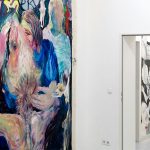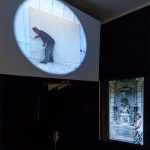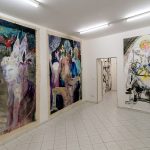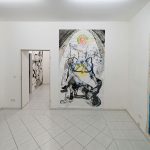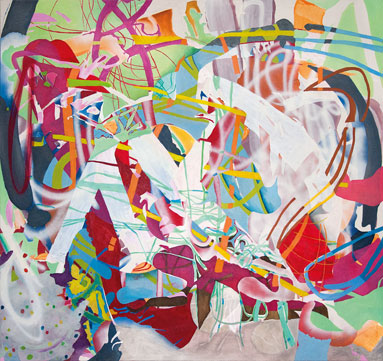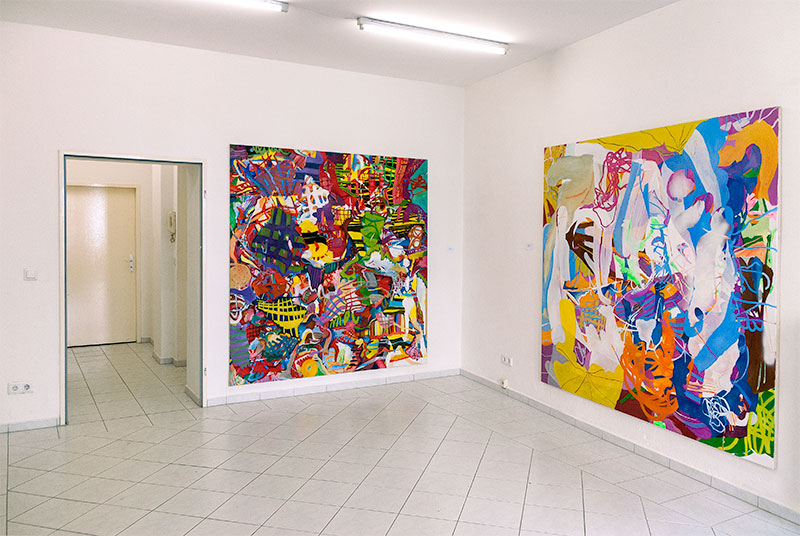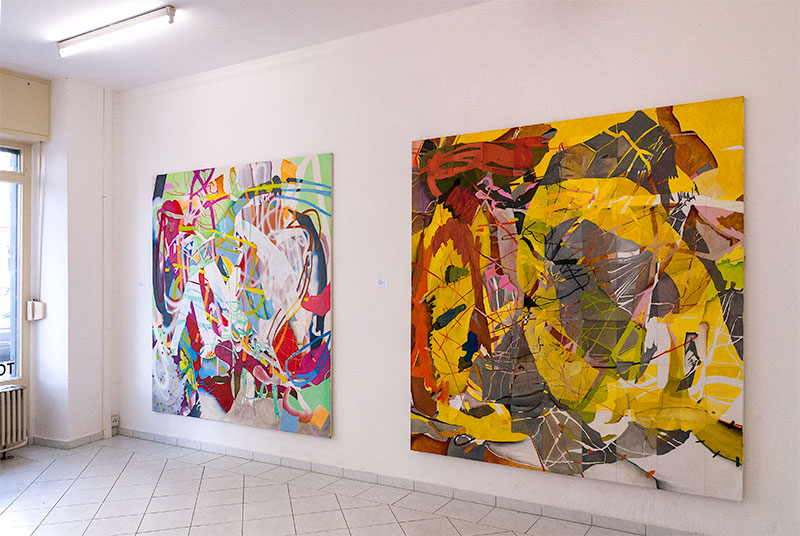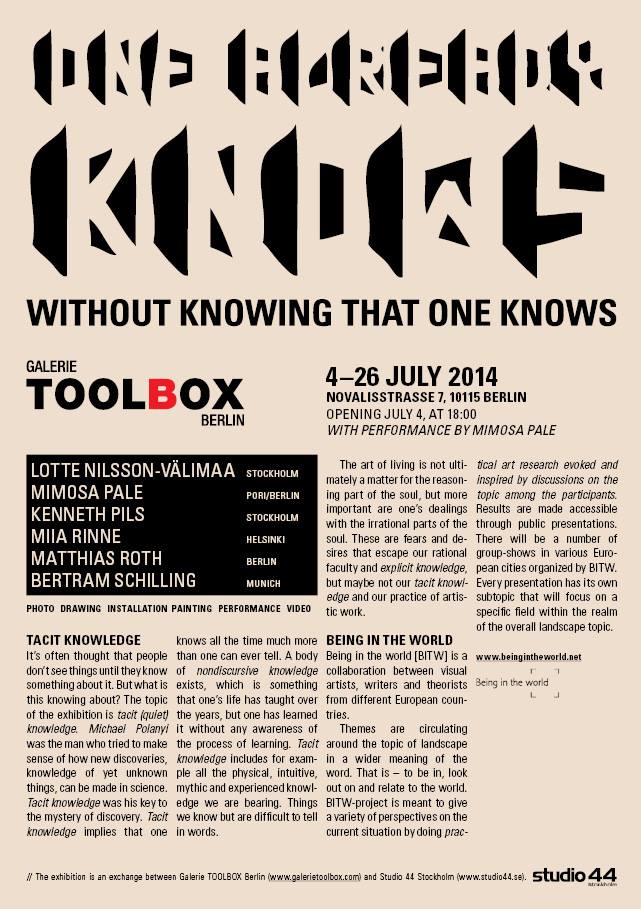
Artists: Lotte Nilsson-Välimaa, Mimosa Pale, Kenneth Pils, Miia Rinne, Matthias Roth, Bertram Schilling
All posts tagged “Painting”
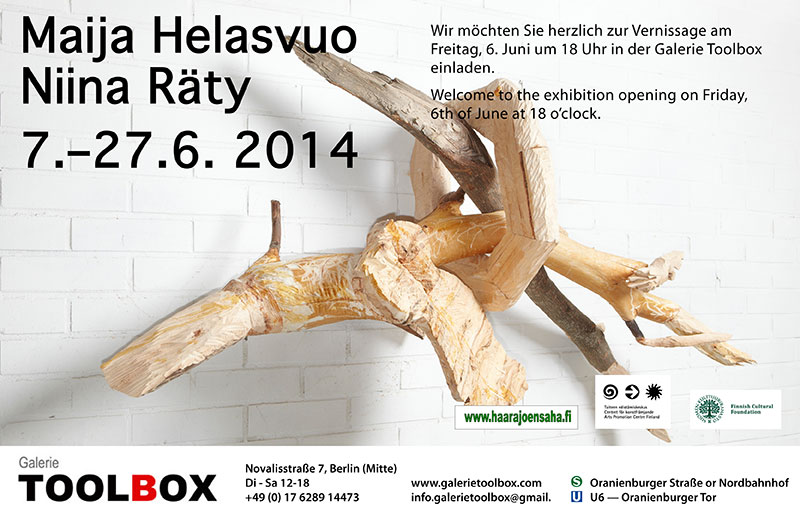
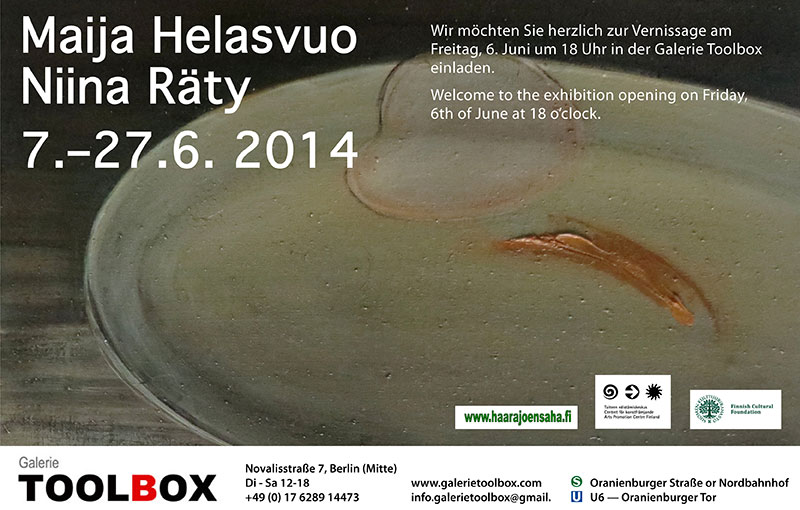
Maija Helasvuo/Niina Räty 7.–27.6.2014
Welcome to the exhibition opening of Maija Helasvuo and Niina Räty
on Friday 6th of June 2014 at 18.00 o’clock at Galerie Toolbox.
Maija Helasvuo, sculptor
At the centre of Maija Helasvuo’s art, are the different levels of human feeling. Her sculptures picture peoples basic emotional dynamic; loss, vulnerability, closeness and our dependence on social interaction. Each person is a part of the complete community of humanity. Through communal experience and all the social forms within it, the process of an event is formed, the connection and interaction of which makes up the whole content of human society.
That which acts on the powerful emotions inside society as a directing force is in one way or another a common factor and causes a process of emotional adaptation. Things that happen in our environment affect us. Helasvuo’s sculptures picture this invisible influence, which is at once adaptable and concrete.
Dr. Mika Karhu
Niina Räty, painter
I mostly paint large multi-part series of works.
I create my own photo album via painting, depicting close people and places as seen through my own experiences. I seek the things that life and existence attach to. I choose a situation or a space that is private and universal like a family gathering, holiday in a summer cottage or a plate on a kitchen table. In my paintings, just like in front of a camera there is a composition; a wedding couple just like other wedding couples around the world, a tourist in front of a local sight forms a picture – a composition that we all are familiar with from our own holiday photos.
We try to capture important moments in our own album and as we take the pictures they represent the form of the event. Compositions using this formula illustrate our own life story. Perhaps through this mechanics of social and spatial being we have a fleeting chance of understanding other people.
Surely painting, restructuring the world on a canvas into a more comprehensible shape is always also a form of self-therapy, organising and tidying up one’s own place, choosing a perspective which helps to tolerate life’s chaos. This aspect of the creative process is, besides sharing and reaching out for another person, central to my artistic work.
Niina Räty
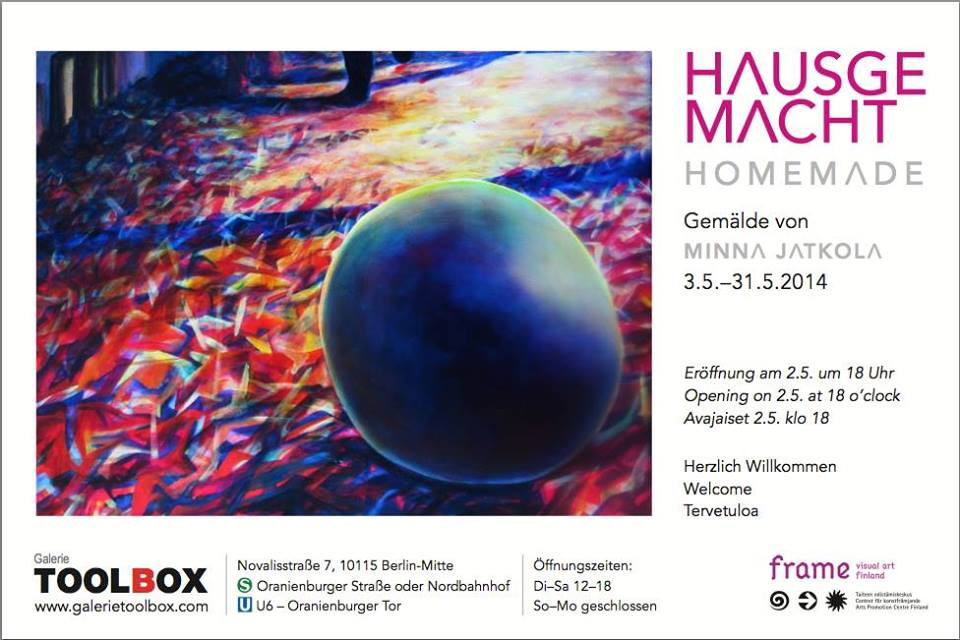
Hausgemacht – Minna Jatkola | 3.5.–31.5.2014
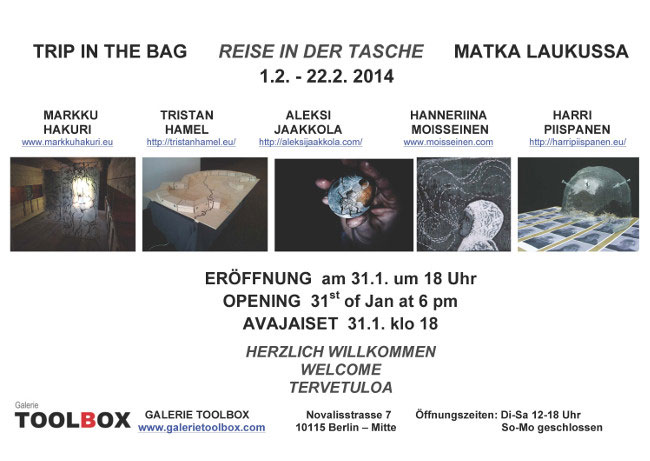
Trip in the Bag | 1.–22.2.2014
he metamorphoses of a bag and its content to an installation, February 1st – February 22nd, 2014
Opening January 31st.
Artists’ homepages: Markku Hakuri, Tristan Hamel, Aleksi Jaakkola, Hanneriina Moisseinen, Harri Piispanen
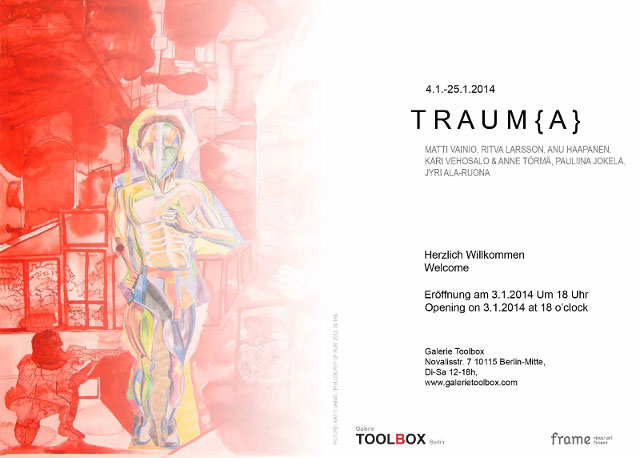
Traum{a} | 4.–25.1. 2014
Vernissage January 3rd.
Artists’ homepages: Anu Haapanen, Jyri Ala-Ruona, Kari Vehosalo, Anne Törmä, Ritva Larsson, Matti Vainio
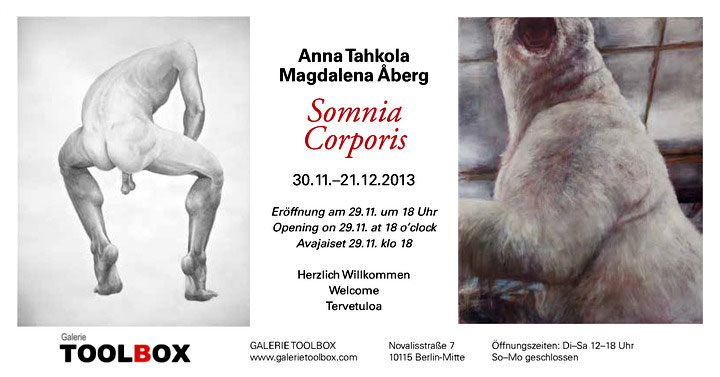
Anna Tahkola & Magdalena Åberg:
Somnia Corporis | 30.11.–21.12.2013
Drawings and paintings
Opening 29.11.2013 at 18 o’clock
Somnia Corporis – körperliche Träume geben den menschlichen Naturkräften, Bedürfnissen und Ängsten ihre Form.
Träume sind nicht nur Träume, sondern auch Phantasien, Vorstellungen, Erwartungen und Ansichten über die Welt. Dies sind physische Gefühle, denn Träumen ist eine physische Eigenschaft. Wie der französische Philosoph Jean-Luc Nancy schreibt:
“Wenn der Körper im Denken begriffen ist, dann zwingt der Körper das Denken dahin, immer weiter, immer zu lang – zu weit, als dass das Denken bloßes Denken bliebe, aber nie so weit, dass es sich materialisieren würde. Deshalb wäre es sinnlos vom Körper und vom Denken als voneinander getrennten Dingen zu reden, als könnten sie je getrennt werden: Sie sind einander die Berührung, in der der eine sich in dem anderen bricht und umgekehrt. Diese Berührung ist die Grenze, der Zwischenraum des Seins. Dennoch hat er einen Namen: Glück, und Leid und Schmerz.”
Die Werke der Ausstellung erzählen von der Möglichkeit und Unmöglichkeit des Seins. Der Genuss im Werk erstarrt unlösbar im unbewegten Bild, in der Haltung des Menschen, des Tieres in seiner natürlichen oder ausgestopften Form, im Ausdruck der Lust oder der Angst.
Der Mensch des Westens lebt als organische Gestalt in einer Welt aufgebauter Strukturen, die sich verändert, reagiert, (er)lebt, kämpft und vermodert. Unter allen polierten und glatten Oberflächen der Gesellschaft schwelt die Sehnsucht nach der Natur außerhalb der Zivilisation. Einer Natur, die in uns allen noch weiterlebt.
Magdalena Åberg (geb.1972) und Anna Tahkola (geb. 1983) sind bildende Künstlerinnen aus Helsinki. In den Gemälden Åbergs kommt das Verhältnis zwischen Mensch und Umgebung in blitzähnlichen Bildern zum Ausdruck. In Tahkolas Bleistiftwerken stellt die Form der Natur und die Stellung des Menschen in Bezug auf die Welt den Ausgangspunkt dar. Unter Zuhilfenahme von Formen beschäftigen sich die Werke beider Künstlerinnen mit Widersprüchen. Aus diesen Widersprüchen entsteht eine Energie, die sich von Innen heraus öffnet, um zu barer Form zu gelangen.
Somnia corporis – Ruumiilliset unelmat antavat muodon ihmisen luonnonvoimille, tarpeille ja peloille.
Unelmat eivät ole vain unia, vaan myös mielikuvia, odotuksia ja käsityksiä maailmasta. Ne ovat fyysisiä tunteita, sillä unelmoiminen on ruumiin ominaisuus. Kuten ranskalainen filosofi Jean-Luc Nancy kirjoittaa:
“Ruumiin ajattelussa ruumis pakottaa ajattelun yhä pidemmälle, aina liian kauan – liian pitkälle, että ajattelu pysyisi ajatteluna, muttei koskaan niin pitkälle, että siitä tulisi ruumis. Sen takia ei ole mieltä puhua erikseen ruumiista ja ajattelusta, ikään kuin ne voisivat olla jotenkin erillään: ne eivät ole kuin toinen toisensa kosketus, jossa yksi murtaa toisen ja murtuu toiseksi. Tämä kosketus on raja, olemassa olon välitila. Silti sillä on nimi: ‘ilo’ ja ‘tuska’ tai ‘kipu’.”
Näyttelyn teokset kertovat olemassaolon mahdollisuuksista ja mahdottomuudesta. Teoksissa nautinto jähmettyy ratkaisemattomaksi liikkumattomassa kuvassa, ihmisen, luonnonmuodon tai täytetyn eläimen asennossa, halun ja pelon ilmeissä.
Länsimainen ihminen elää rakennetun järjestyksen maailmassa orgaanisena muotona, joka muuttuu, reagoi, nauttii, kamppailee ja maatuu. Yhteiskunnan kaikkien kiillotettujen, sileiden pintojen alla piilee kaipuu sivilisaation ulkopuolella olevaan luontoon. Luontoon, joka meissä kaikissa on vielä jäljellä.
Magdalena Åberg (s.1972) ja Anna Tahkola (s. 1983) ovat helsinkiläisiä kuvataiteilijoita. Åbergin maalauksissa ihmisen ja ympäristön suhde valottuu välähdyksenomaisina kuvina. Tahkolan lyijykynäteoksissa lähtökohtana on luonnon muoto tai ihmisen asento suhteessa maailmaan. Molempien taiteilijoiden teokset tutkivat muotojen kautta sitä, mikä on ristiriitaista. Ristiriidasta syntyy energiaa, joka aukeaa sisältäpäin saavuttaakseen paljaimman muotonsa.
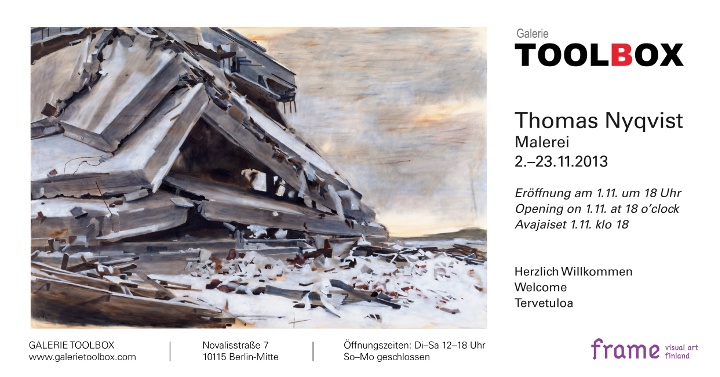
Thomas Nyqvist: Paintings
2.–23.11-2014
Vernissage November 1st, 18 o’clock
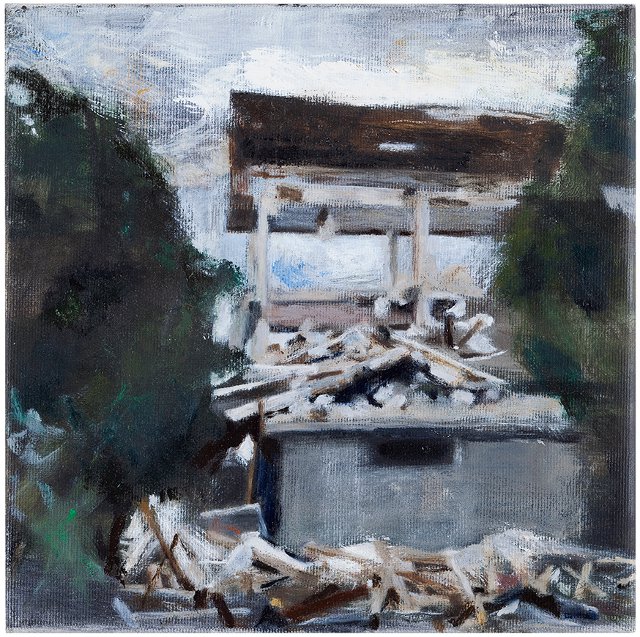
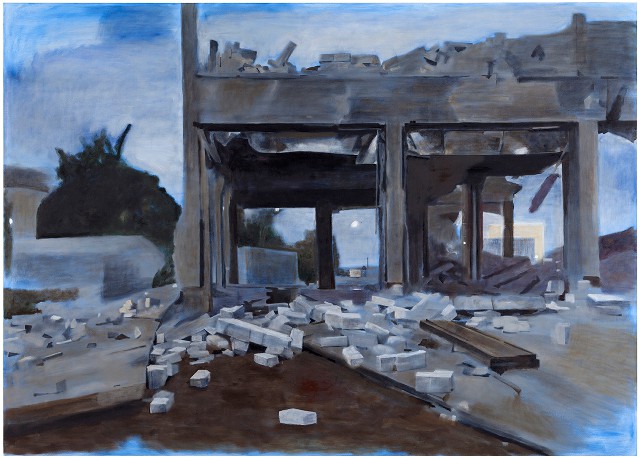
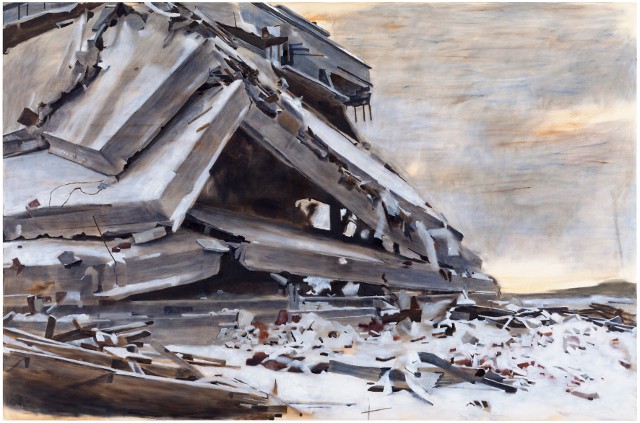
In seiner Kunst stellt Thomas Nyqvist die Frage: was bedeuten Marginalien und Ruinen für die Lebenswelt des Menschen? Der Ausgangspunkt für sein Werk ist der Abriss von Industriegebäuden in seiner Heimatstadt Helsinki. Er gestaltet diese Gebäude wie gefundene Ruinen, der Abriss und seine Mechanismen werden ausgelassen. Was bleibt ist ein Objekt, das sich der Kategorie Ruine zuordnet. Nyqvists Hintergrund im abstrakten Expressionismus wird in den Ruinemotiven deutlich, bei welchen es sich sowohl in Hinsicht auf den Inhalt als auf die Form um einen Kampf zwischen Bau und Zerstörung, Ordnung und Chaos handelt.
In his paintings Thomas Nyqvist poses a question concerning the meaning of ruins and margins in the human world. The starting point for his work is the tearing down of industrial buildings in his native city, Helsinki. In the paintings the buildings are shown as ‘found’ ruins, and the actual process of demolishing and its mechanisms are effaced. What is left is an object, which belongs to the category of ruin. His background in Abstract Expressionism asserts itself in these ruin motifs, which deal – both in content and formally – with the struggle between building and dilapidation, and between order and chaos.
Beauty Box
7.–28.9.2013
Robin Lindqvist, Veronika Ringbom,
Henry Wuorila-Stenberg
Robin Lindqvist: Unknown Object, 2013, oil on canvas Veronika Ringbom: Sanguinario, 2012, carborundum and drypoint Henry Wuorila-Stenberg: Christ, 2012, watercolor
Three very different artists, Robin Lindqvist, Veronika Ringbom and Henry Wuorila-Stenberg show paintings, prints and drawings. Artist and curator Jan Kenneth Weckman ties the works together by suggesting, if these works can be investigated in the light of beauty? The distance between the proposal and works might also be transformed in to a question about the being of beauty.
Is it a question about the beautiful, the way all kinds of things may be displayed, or are we able to talk about beauty as a thought, a goal or as an ethos (in art as well)?
The exhibition does not give answers, only builds a space for inquiry, in which we take up a position, each one on our own, like the light, that floods on the work. What do we see, if we ask about beauty in art and in life?
More information about the artists:
Robin Lindqvist (PDF)
Veronika Ringbom (PDF)
Henry Wuorila-Stenberg (PDF)
Read more about the proposal and discussion around the idea of beauty and contemporary art here. (PDF)
Niina Räty
3.–31.8.2013
Exhibition opening 2nd of August at 18 o’clock.
Welcome!
Niina Räty: At the Beach, Tero 2008, 2013, Oil on linen
“I mostly paint large multi-part series of works.”
“I create my own photo album via painting, depicting close people and places as seen through my own experiences. I seek the things that life and existence attach to. I choose a situation or a space that is private and universal like a family gathering, holiday in a summer cottage or a plate on a kitchen table. In my paintings, just like in front of a camera there is a composition; a wedding couple just like other wedding couples around the world, a tourist in front of a local sight forms a picture – a composition that we all are familiar with from our own holiday photos.”
“We try to capture important moments in our own album and as we take the pictures they represent the form of the event. Compositions using this formula illustrate our own life story. Perhaps through these mechanics of social and spatial being we have a fleeting chance of understanding other people.”
Minna Jatkola & Juhana Moisander
29.6.–27.7.2013
Juhana Moisander: The Temptation, 2012 video projection, table, apple
Installations & Paintings
Press Release in English (pdf)
Pressemitteilung auf Deutsch (pdf)