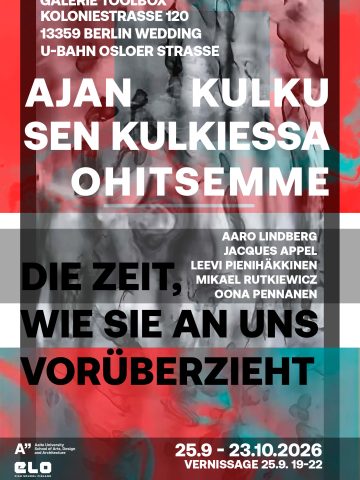
Warmly welcome to the nex exhibition in Toolbox Finnish German Art Space Berlin. This time we present the following Artists:
- Dr. Riitta Rainio Research Team
- Niina Räty Paintings
- Maija Helasvuo Sculptures
Opening | Vernissage: Friday, 27.02.2026, 7–10 pm | 19–22 Uhr
Open on Kolonie Weekend: Sunday 01.03. : 2-6 pm | 14-18 Uhr
Exhibition | Ausstellungsdauer: 1.–21.03.2026
Sonic Wonderland – Visuo-Acoustic Simulations of Echoing Rocks
Jami Pekkanen, Julia Shpinitskaya, Noora Vikman, Elina Hytönen-Ng, Gjermund Kolltveit, Riitta Rainio
Sonic Wonderland’s visuo-acoustic simulations take visitors to some of Finland’s most stunning acoustic environments: the echoing rock paintings of Siliävuori and the resonant cavity of Hiidenkirnukivi. Digital modeling and auralization methods conjure up what these sacred sites of the past look and sound like. The simulations are interactive, which means that in order to hear the echoes, visitors must produce sound themselves, for example by calling out, clapping, or playing the instrument
The SacredSounds research project, funded by the Kone Foundation (2023–2027), traces and highlights the unrenowned acoustics heritage of Fennoscandia. Researchers from the Universities of Helsinki and Eastern Finland perform acoustic measurements at cliffs, boulders, caves, and gorges held as sacred or special, and document the sites using LiDAR scanning, aerial videography, and photography. They also conduct archival research and interviews to find out how people have experienced these places at different times.
More information:
riitta.rainio@helsinki.fi
Fish
Niina Räty
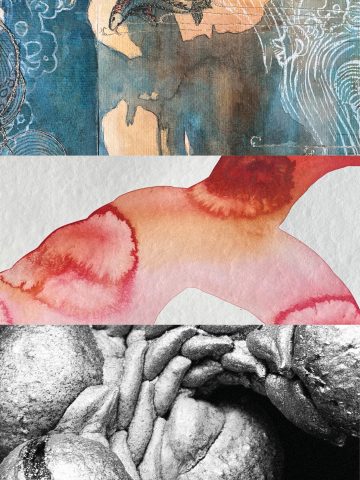
For the past five years, fish have been my subject matter. Pike-perch, perch, and herrings – sometimes lying on wax paper, sometimes on a plate. What is it about these shiny creatures that fascinates me?
Still-life painting fascinates me. It is about learning to look at things. The history of painting is full of still lifes of fish – silver-sided fish on silver platters, coarse fish scales depicted together with translucent onions, or moist seafood gleaming on the dirty counter of a market stall. As a motif, a fish is loaded with meanings, often Christian ones. Above all, it often seems to reflect the pure joy of painting – the pleasure that comes from seeking light and shine.
Of course, fish themselves are intriguing too. Smelly, even repulsive, oblong creatures, strange and mute. Fish are valuable yet unfamiliar, lifted up from beneath the surface for food. The boundary between two worlds is broken just like that.
Most of all, however, I am interested in the similarity. The fish is matter, just like the painting, the viewer, and the painter. The same clammy, speechless substance. By painting fish, I paint all of us – chunks of flesh dragged into this unfamiliar environment without asking.
Thank you
Kone Foundation and Alfred Kordelin Foundation
Maija Helasvuo
My sculptures address the experience of life being limited, our dependence on our own physical existence and especially on other people.
A human is part of a human community. The fields of our social interactions largely define the framework of our actions. Even our separation and isolation always stand in relation to others. Our ability to be intimate is the starting point of our existence. Our ability to take care carries us from one generation to another. Independence is inevitable, yet even our independence stands in relation to others, our diverse communities.
As neither the fields of interaction surrounding us nor our relations to others can be physically touched by the hand, we need sculptures to concretize these abstract experiences. In my view and experience, a sculpture still is a functioning means of symbolic thinking for human communities. In practice, this has already been the case since early cult objects.
Creating a sculpture is slow, at least for me. My themes develop slowly, if at all.
My topics of limitations and dependence on others intertwine and reveal themselves repeatedly. The material’s resistance is important to me. The physicality of creating a work is often enjoyable. The slowness in working with the material and the physical effort create time for thinking and for the opportunity to calmly solve sculptural problems.
I tend to get the impression that the slowness in making a sculpture does not prevent, but in fact assists the sculpture opening up to its viewer as an abrupt experience, even resembling a physical shock.
The viewer is important to me. The sculpture is a means to communicate with and within the community.
Maija Helasvuo
Sculptor, MFA
Deutsch e Übersetzung des Textes von Maija Helasvuo:
Meine Skulpturen thematisieren das Erlebnis der Begrenztheit des Lebens, unsere Abhängigkeit von der eigenen physischen Existenz und insbesondere von anderen Menschen.
Ein Mensch ist Teil menschlicher Gemeinschaft. Unsere sozialen Interaktionsfelder bestimmen zu großen Teilen die Rahmenbedingungen unseres Handelns. Sogar unsere Abgrenzung und Isolation stehen immer in Beziehung zu anderen. Unsere Fähigkeit zu Intimität ist der Ausgangspunkt unserer Existenz. Unsere Fähigkeit sich um andere zu sorgen trägt uns von Generation zu Generation. Selbstständigkeit ist unabdingbar, und doch steht auch sie in Beziehung zu anderen, zu unseren vielfältigen Gemeinschaften.
Da wir weder die uns umgebenden Interaktionsfelder noch unsere Beziehungen zu anderen mit den Händen greifen können, brauchen wir Skulpturen als eine Konkretisierung unserer abstrakten Erlebnisse. Ich fühle und sehe Skulpturen weiterhin als funktionierendes Mittel des symbolischen Denkens menschlicher Gemeinschaften. Tatsächlich gilt dies bereits seit frühzeitlichen Kultobjekten.
Galerie/Projektraum TOOLBOX
Koloniestraße 120
13359 Berlin-Wedding
U-Bahn Osloer Straße
An Feiertagen ist die Toolbox geschlossen
On Bank holidays Toolbox is closed