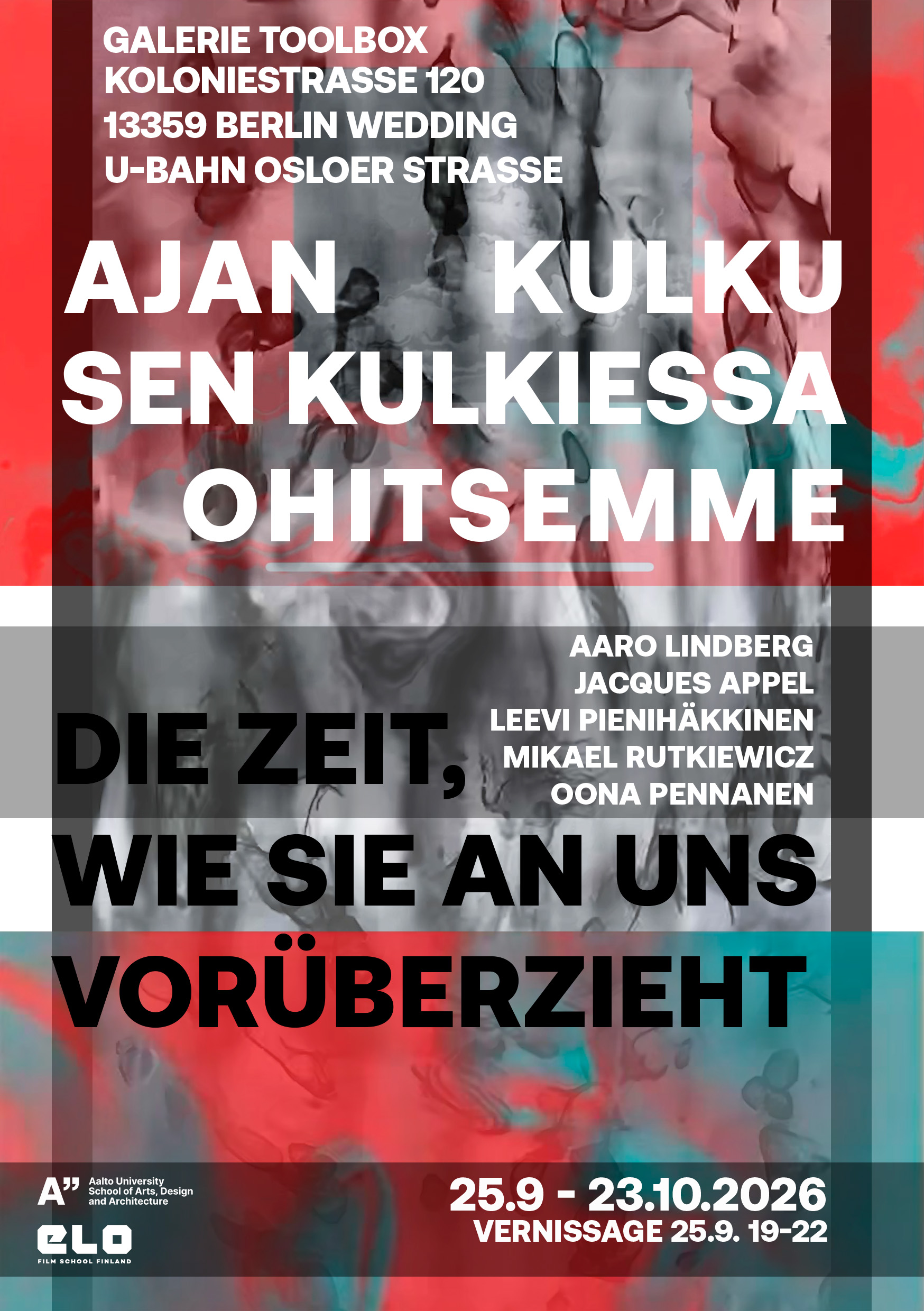
Open on Kolonie Weekend Sat 26.9.: 2–5 pm Sun 27.9.: 2–5 pm
Exhibition: 25.9.-23.10.2026
Opening hours: Tue–Fri 2–6 pm
Finnish students bring their video works to Berlin. Die Zeit, wie sie an uns vorüberzieht is a collection of audiovisual works made by Aaro Lindberg, Jacques Appel, Leevi Pienihäkkinen, Mikael Rutkiewicz and Oona Pennanen. Each work brings their own piece to the puzzle of time and place. Where are we? When? Who are we? Now? Then?
The exhibition is part of the Associative Visual Storytelling course for Master students in the Film and Animation department at Aalto University, Finland. The course is led, and the exhibition is organized by visual artist and university pedagogue Dr. Mika Karhu.
Deutsch
Finnische Studierende bringen ihre Videoarbeiten nach Berlin. „Die Zeit, wie sie an uns vorüberzieht“ ist eine Sammlung audiovisueller Arbeiten von Aaro Lindberg, Jacques Appel, Leevi Pienihäkkinen, Mikael Rutkiewicz und Oona Pennanen. Jede Arbeit fügt dem Puzzle aus Zeit und Ort ein eigenes Stück hinzu. Wo sind wir? Wann? Wer sind wir? Jetzt? Damals?
Die Ausstellung ist Teil des Kurses „Associative Visual Storytelling“ für Masterstudierende des Fachbereichs Film und Animation an der Aalto-Universität in Finnland. Der Kurs wird geleitet und die Ausstellung organisiert vom bildenden Künstler und Hochschulpedagogen Dr. Mika Karhu.
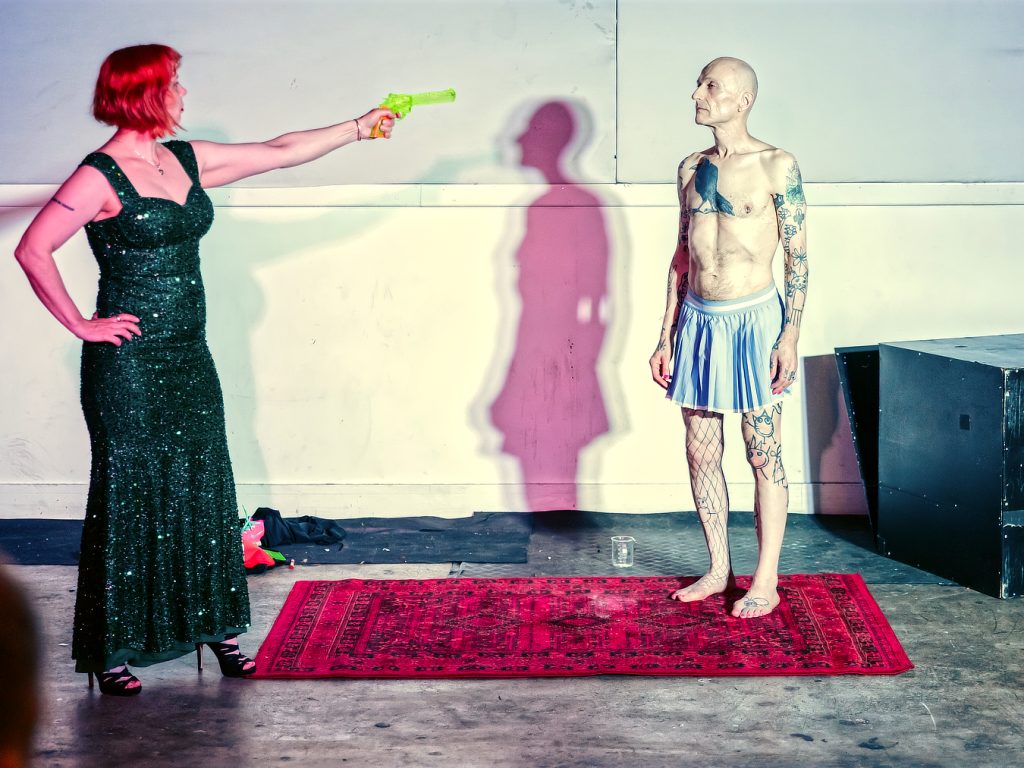
Opening Fri 28 August 2026: 7–10 pm Performance on the opening by Kainulainen & Latva at arround 8 pm
Kainulainen & Latva: Untitled (Pisstol) London, 2026 Future Ritual: DISCHARGE, hosted by IKLECTIK. Photo by Henri T
Open on Kolonie Weekend Sat 29.8.: 2–5 pm Sun 2308.: 2–5 pm
Exhibition: 29.8..–18.9.2026
Opening hours: Tue–Fri 2–6 pm
Maximilian Latva
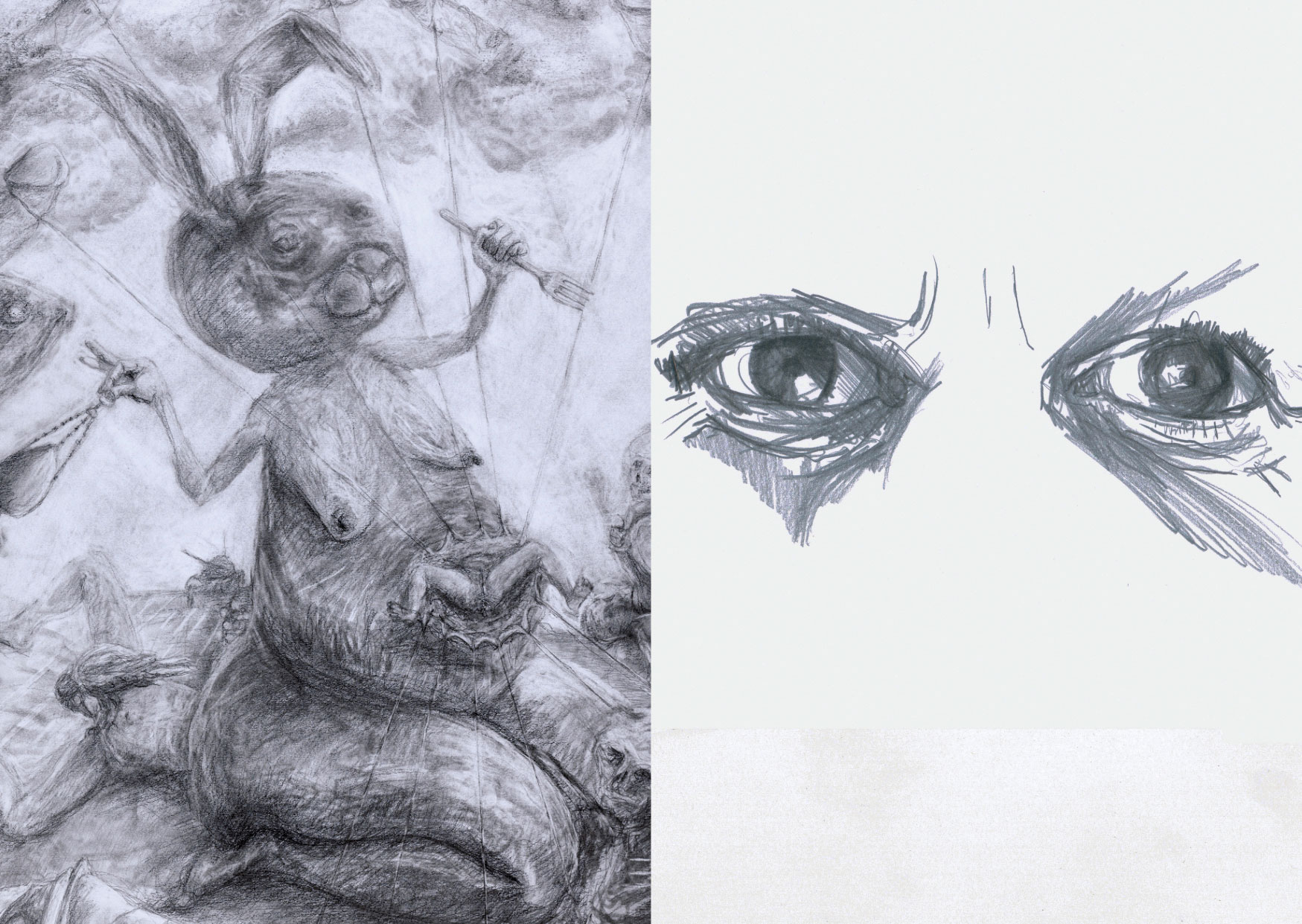
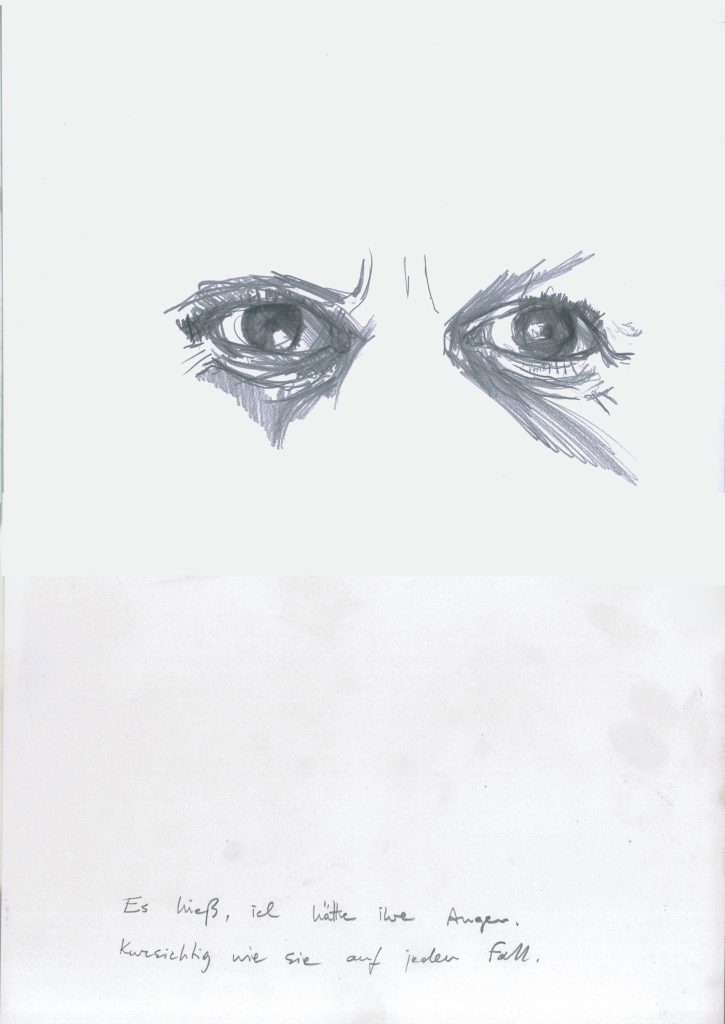
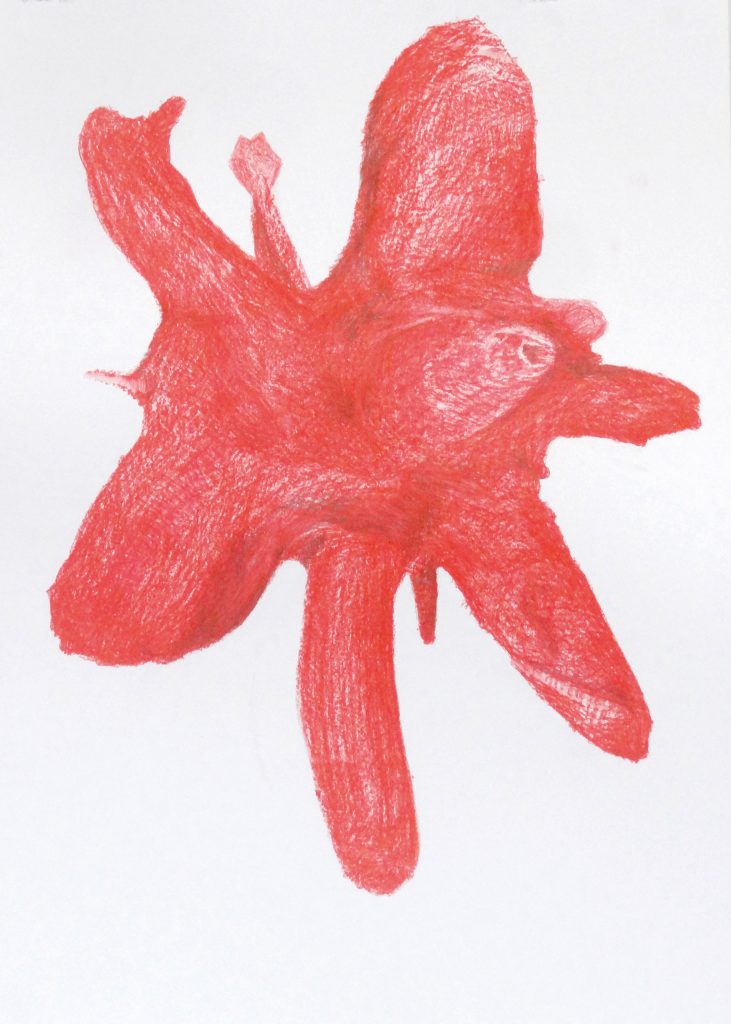
Please Please Me is a series of drawings, made during 2026 with pencil and craphite dust on paper.
artwork on top. Inner Beauty Pageant Runner-up, pencil and graphite dust on paper, 75 x 55 cm, 2026
Please Please Me. The smiling voice, the bouncy beat, over and over. That’s the song I used to dance to, alone, as a kid. It was the only record with a pulse among the few dusty vinyls my mom had, so I danced to it even though I didn’t really like it. Maybe the rhythm let me escape the shame and pain in my body for a while.
The record of my childhood got scratched early on. It keeps skipping back, and the past becomes the present again and again. Paper scratches too. Pencil drawing is raw and bare, hiding nothing. Graphite has no undo function, mistakes can’t be completely erased, but they can lead to new things. These imperfections become guides to my unconscious, revealing secrets I have no words for.
Latva
CV; Maximilian Latva (b. 1966) is a Finnish artist. Based in Helsinki, Latva works with drawing, performance art and sound. As a performance artist, they have collaborated with Katri Kainulainen in the duo Kainulainen & Latva since 2014. In 2026, Maximilian was granted a 5-year working grant by the Finnish Arts and Culture Agency. Link to Curriculum Vitae
Ralf Tekaat, born in 1970 in Bobingen, Germany, studied Visual Communication before studying Fine Arts at the Hochschule für Künste Bremen from 1997 to 2002 under Wolfgang Schmitz and Paco Knöller. After graduating, he continued his studies as a Meisterschüler (postgraduate master student) under Paco Knöller in 2002. Since 2005, Tekaat has taught at both the Hochschule für Künste Bremen and the University of Bremen as part of several teaching appointments. His work has received various awards and grants, including a grant in 2017 for a working residency in Spitsbergen, Norway. In 2026, he is scheduled to undertake a working residency in the Atacama Desert in Chile. Tekaat lives and works in Berlin.
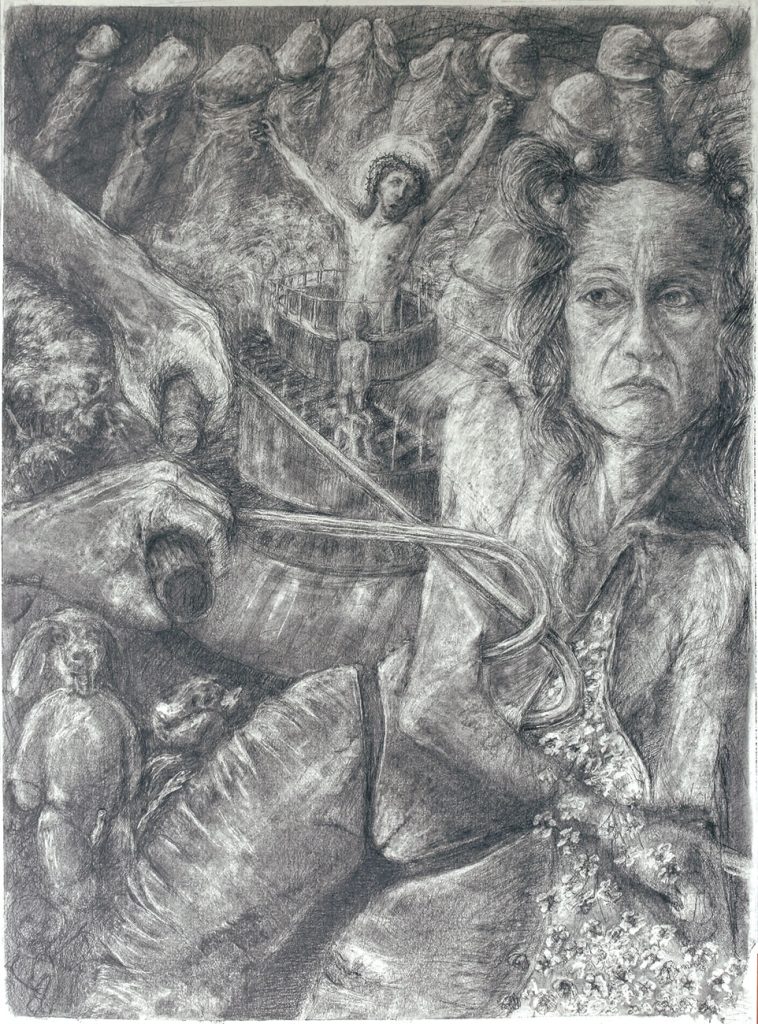
Tekaat’s artistic practice is primarily rooted in drawing and focuses predominantly on works on paper. In his large-scale pencil drawings, pictorial objects gradually emerge from densely layered cross-hatching, creating the impression of a slow, almost sedimentary process of construction. In contrast, his expansive wall installations shift the focus towards narrative structures. Here, Tekaat connects autobiographical fragments with images from collective memory, creating complex and multilayered visual spaces of narration.
In his installation Hidden Track, – shown at Toolbox – Tekaat addresses the early death of his mother. She died of cancer more than 30 years ago.
When he remembers her, he always sees her as she was when she was already ill, rather than as she was when she was still healthy and carefree. The period during which she was severely affected by cancer was actually short, but it has come to dominate his memory of her.
One evening, while watching the Beatles film A Hard Day’s Night, he thought he saw his mother among the screaming crowd. Could it have been her? In 1963, in her early twenties, she spent an extended period in England as part of an exchange programme. The details of her time there had to remain secret, at least from her parents, even later on. This could explain why the concert was never spoken about either. Just as the illness was never talked about. In the work, the illness is connected with and set against the music of the Beatles, which for Tekaat represents a so-called “safe place”.
In fragmentary moments, he recalls incidents from his childhood and adolescence with his mother. Moments in which the illness, which was otherwise never spoken about in his presence, gradually seeped into what had seemed to be an untroubled family life. He tries to make the possibility that his mother really did have a brief, screaming, blissful appearance in that Beatles film seem real.
Ralf Tekaat, geboren 1970 in Bobingen, studierte Visuelle Kommunikation, bevor er von 1997 bis 2002 Freie Kunst, an der Hochschule für Künste Bremen bei Wolfgang Schmitz und Paco Knöller, studierte. Nach dem Diplom schloss sich 2002 ein Meisterschülerstudium bei Paco Knöller an.
Seit 2005 war Tekaat im Rahmen mehrerer Lehraufträge sowohl an der Hochschule für Künste Bremen als auch an der Universität Bremen tätig. Seine Arbeit wurde mit verschiedenen Preisen und Stipendien ausgezeichnet; 2017 erhielt er unter anderem ein Stipendium für einen Arbeitsaufenthalt auf Spitzbergen (Norwegen). 2026 ist ein Arbeitsaufenthalt in der Atacama Wüste in Chile geplant. Tekaat lebt und arbeitet in Berlin.
Tekaats künstlerische Praxis ist primär zeichnerisch geprägt und konzentriert sich überwiegend
auf Arbeiten auf Papier. In seinen großformatigen Bleistiftzeichnungen entstehen die Bildobjekte sukzessive aus dicht gelagerten Schraffurschichten, die den Eindruck eines langsamen, beinahe sedimentären Aufbaus vermitteln. Demgegenüber verschiebt sich in den raumgreifenden Wandinstallationen der Fokus hin zu narrativen Strukturen: Hier verknüpft Tekaat autobiografische Fragmente mit Bildern des kollektiven Gedächtnisses und erzeugt so vielschichtige visuelle Erzählräume.
In seiner Installation Hidden Track, die er bei Toolbox zeigt, thematisiert Tekaat den frühen Tod seiner Mutter. Vor über 30 Jahren starb sie an Krebs. Wenn er sich an sie erinnert, sieht er sie immer nur vor sich, als sie schon krank war, und nicht so, wie sie war, als sie noch gesund und unbeschwert war. Dabei war die Zeit, in der sie von dem Krebs stark gezeichnet war, nur kurz, aber eben dominierend.
Als er eines Abends den Beatles-Film A Hard Day’s Night sah, dachte er, seine Mutter in der kreischenden Menge zu sehen. Könnte sie es gewesen sein? Sie war 1963, mit Anfang 20, für längere Zeit im Rahmen eines Austauschs in England. Die Details davon mussten, zumindest vor ihren Eltern, auch später noch geheim gehalten werden. So wäre zu erklären, wieso auch über jenes Konzert nie gesprochen wurde. So wie auch über die Krankheit nicht geredet wurde.
In der Arbeit wird die Krankheit mit der Musik der Beatles, die für Tekaat ein sogenannter „sicherer Ort“ ist, verknüpft und ihr gegenübergestellt.
Bruchstückhaft, in kurzen Momenten, erinnert er sich an Begebenheiten seiner Kindheit und Jugend mit seiner Mutter. Begebenheiten, in denen die Krankheit, über die sonst in seiner Gegenwart nicht gesprochen wurde, mehr und mehr in das scheinbar ungetrübte Familienleben einsickerte. Er versucht, die Möglichkeit, dass seine Mutter tatsächlich in jenem Beatles-Film einen kurzen, kreischenden und glückseligen Auftritt hatte, als wahr erscheinen zu lassen.
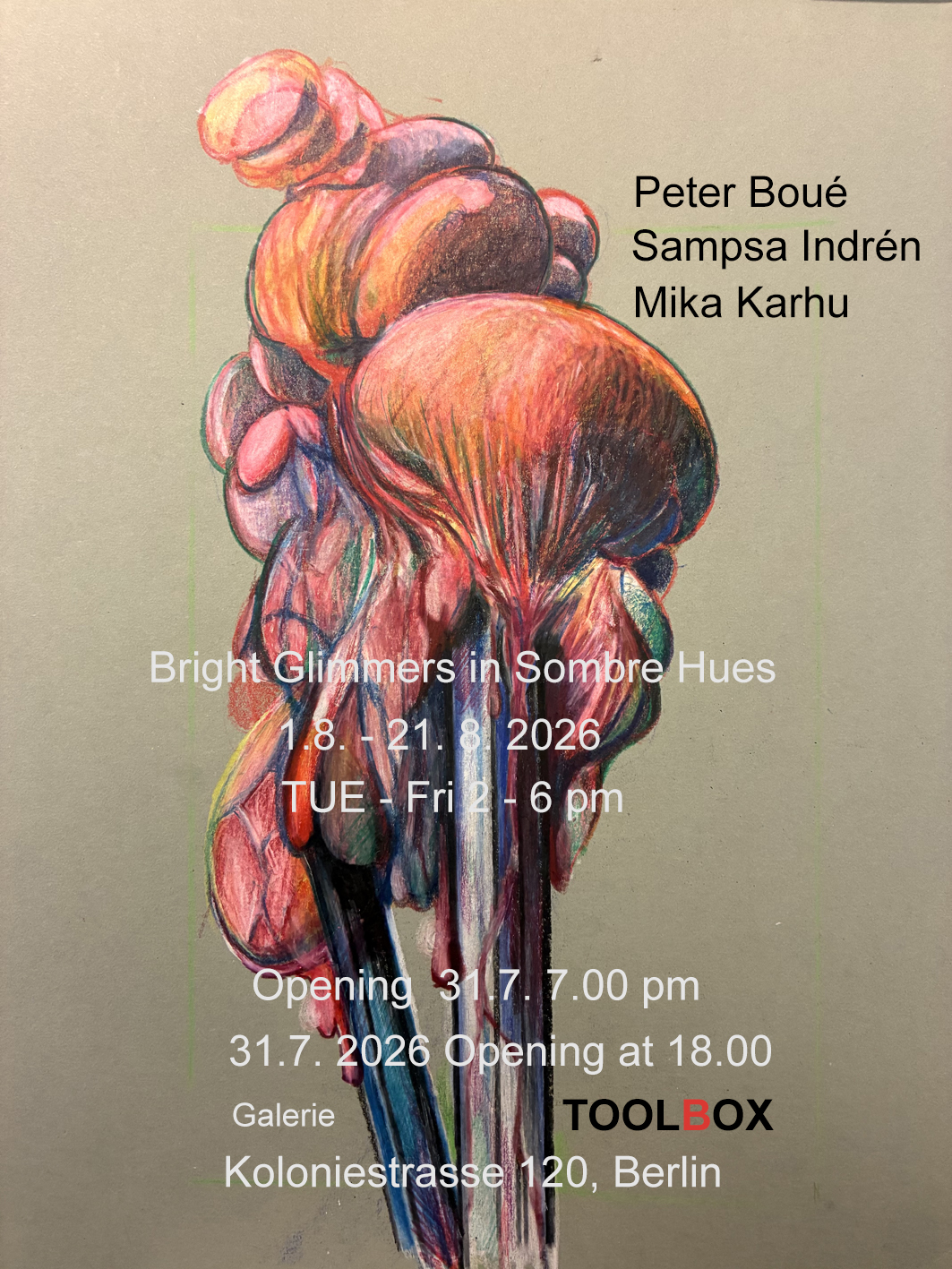
Galerie/Projektraum TOOLBOX presents the exhibition Bright Glimmers on Sombre Hues
Artists: Peter Boué, Sampsa Indrén, Mika Karhu
Opening Fri 31 July 2026: 6–10 pm
Open on Kolonie Weekend Sat 1.8.: 2–5 pm Sun 2.8.: 2–5 pm
Exhibition: 1.–21.8.2026
Opening hours: Tue–Fri 2–6 pm1.8.–21.8.2026
Light never exists in isolation. It becomes perceptible only in its encounter with shadow. Likewise, the world does not disclose itself as a completed whole but through fractures, interruptions, and fleeting illuminations that emerge from the darker fabric of experience. Bright Glimmers on Sombre Hues explores these fragile moments—not as opposites to darkness, but as possibilities that arise from within it.
The works gathered in this exhibition resist reconciliation. They inhabit a terrain where meaning remains unfinished and reality refuses stable interpretation. Their luminous moments do not lead us beyond darkness; rather, they render its structure visible. Illumination here is neither revelation nor redemption, but a brief suspension in which the familiar world becomes estranged from itself, allowing another way of seeing to emerge.
In art, light is more than an optical phenomenon; it is a mode of thought. It marks the instant when habitual perception falters and experience opens toward what has not yet been named. The artwork offers no resolution. Instead, it constructs a space in which the world may be encountered anew—not as an object to be mastered, but as an event unfolding between material, memory, history, and perception. Meaning resides neither in the work nor in the viewer alone, but in the dynamic relation that continually forms between them.
This exhibition rejects optimism as the antidote to darkness. Hope is conceivable only where the contradictions of the world remain visible. Beauty does not arise from promises of harmony but from the capacity to dwell within incompleteness without dissolving it into certainty. Every bright glimmer is a temporary interruption in the sombre hues of existence—a moment in which something still unnamed becomes perceptible.
Bright Glimmers on Sombre Hues invites us to remain within this tension. Light never abolishes shadow, nor does shadow extinguish light. Together they constitute the horizon through which experience acquires depth and complexity. In these fleeting illuminations, art reveals what conceptual thought alone cannot fully grasp: meaning does not exist beyond contradiction but emerges through its continuous movement.
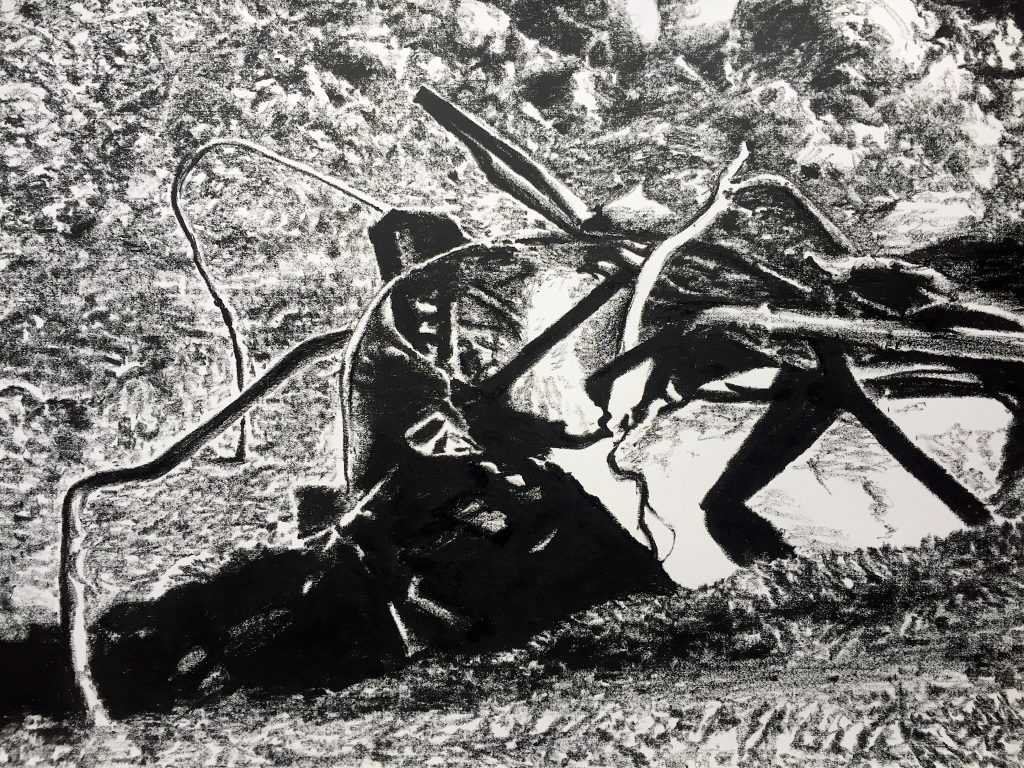
Artwork: Überrest, 2021, Fettkreide auf Karton | oil pastel on cardboard,, 70×100 cm
In ihrer Reduktion auf den Schwarz-Weiß-Kontrast führen die Zeichnungen die dargestellten Orte und Szenen auf ihre Grundelemente zurück. Zugleich rücken sie die magischen Momente, das üblicherweise Ausgeblendete in den Fokus. Sie leuchten den Wirklichkeitsgehalt des Surrealen aus. Sie suchen die Realität in einem Schattenreich. Der Schwarz-Weiß-Kontrast verstärkt den Charakter des Unwirklichen.
Der Schatten entstammt nicht einer konkreten Lichtquelle, er ist häufig deutlicher als der Gegenstand selbst beziehungsweise nimmt fast die Gestalt von Figuren an, mutiert zum aktiven Element. Ebenso erscheint das Licht in einer eigenen Gegenständlichkeit auf einer Skala zwischen Glimmen und gleißenden Flammen. So treten Licht und Schatten als Akteure auf, die ihr jeweiliges Erscheinungsbild aus sich selbst speisen. Mit Schattierungen modelliert Boué eine diffuse Gegenständlichkeit, die sich dem Auge zugleich anbietet und entzieht.
—————————
In their reduction to black-and-white contrast, the drawings reduce the depicted places and scenes to their basic elements. At the same time, they bring the magical moments, the things that are usually hidden, into focus. They illuminate the reality of the surreal. They seek reality in a realm of shadows. The black-and-white contrast reinforces the character of the unreal.
The shadow does not originate from a specific light source; it is often clearer than the object itself or almost takes on the form of figures, mutating into an active element. Similarly, light appears in its own objectivity on a scale between glimmering and glistening flames. Thus, light and shadow appear as actors that feed their respective appearances from within themselves. With shades, Boué models a diffuse objectivity that simultaneously presents itself to the eye and eludes it.
Galerie/Projektraum TOOLBOX presents an exhibition with:
Krista Autio, Brussels (Painting) and Fanny Spång, Berlin (Sculpture) Exhibition: 30.5.– 19.6.2026 Opening Fri 29 May: 7–10 pm
Open on Kolonie Weekend Sat 30 May: 2–5 pm Sun 31 May: 2–5 pm
Opening hours: Tue–Fri 2–6 pm
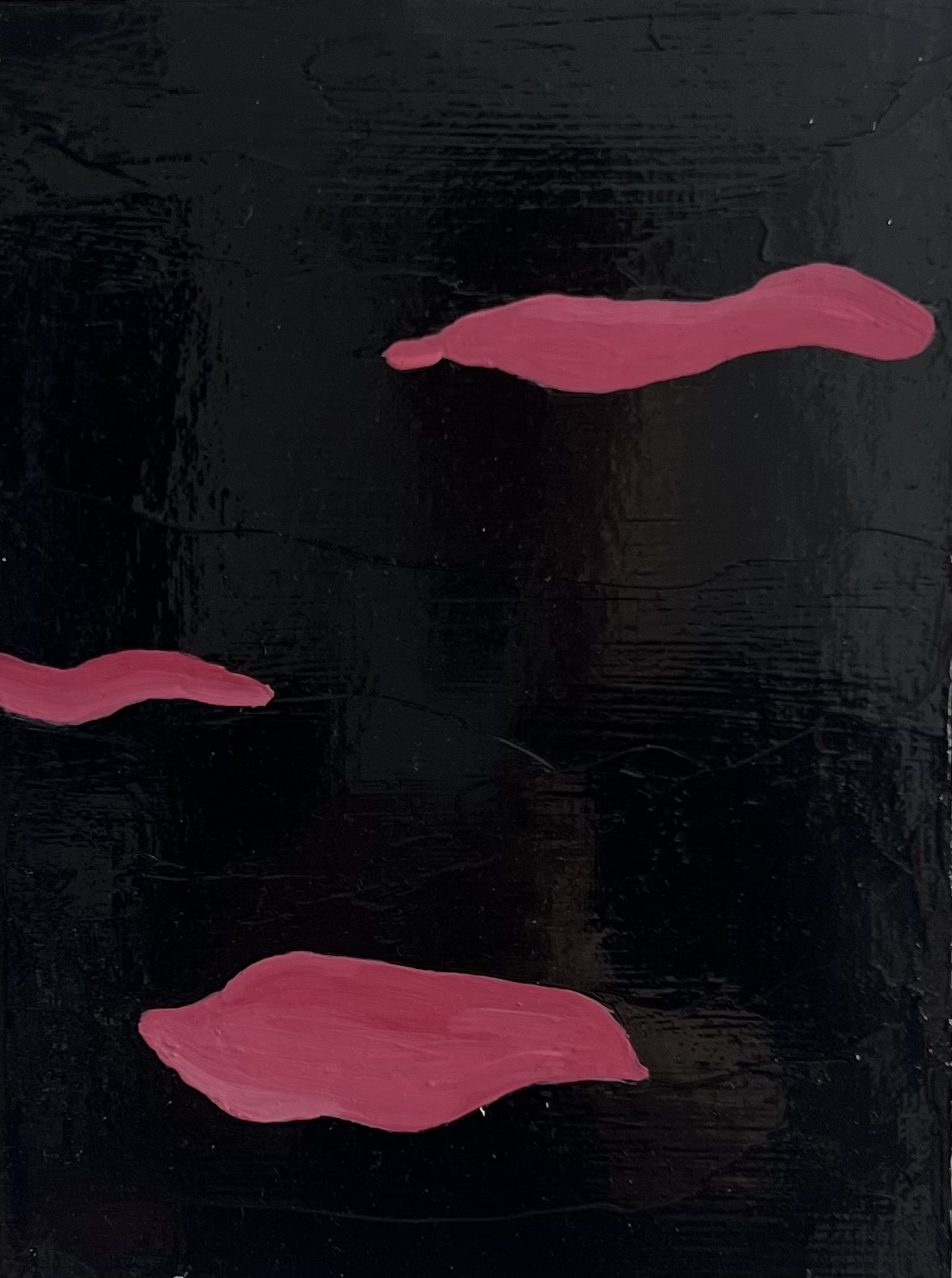
Artwork (top) Krista Autio: Oil painting from the series Fleeting Happiness
I long for the land that is not, because all that exists, I’m too weary to want. The moon speaks to me in silvern runes About the land that is not. The land where all our dreams become wondrously fulfilled, The land where all our fetters fall, The land where we cool our bleeding forehead In the dew of the moon. My life was a burning illusion But one thing I have found and one thing I have really won – The road to the land that is not.
The Land That Is Not, poem by Edith Södergran
Krista Autio, painting
Fleeting happiness
Fleeting Happiness is a series of paintings about moments of happiness that pass quickly, moments we miss, reminisce about, and long to experience again. These moments often remain in our memories as something both melancholic and beautiful, almost ethereal. Such feelings especially affect people who have left or lost their homeland due to different circumstances. In today’s challenging world, we want to hold on to small, fleeting moments of happiness. The paintings and sculptures in this exhibition relate to these fleeting experiences, especially those connected to nature, memory, and a sense of belonging.
Krista Autio is a Finnish painter who lives and works in Brussels, Belgium. Her work is thus influenced by the everyday lives, habits, daily rhythms and art from the countries where she has lived–France, Spain, and Belgium–while maintaining an intrinsically Finnish ethos of looking for the simple, essential qualities of a story or image.
Autio works primarily with oil paint at a large scale, creating multiple layers using a palette knife. The works begin as process-based, meditative journeys into the true essence of colors and often contain drawings and snippets of text. Later, she erases elements she deems unnecessary, paring down the image to just one color, shape, or image.
Recently, her interest has been in Finnish happiness. She began to explore the concept of happiness when the World Happiness Report had chosen Finland as the happiest country in the world several times. Her first exhibition on this topic was in the fall of 2024 ”Where is the fucking happiness?” at NOoSPHERE Arts, NYC.
Her works have been exhibited in Finland, Belgium, Spain, France, the Netherlands, Luxembourg, and the United States. Autio founded the contemporary art project space K41 nordiKey in Brussels in 2017, where she works as a curator. The space mainly showcases the works of Nordic contemporary artists living in Belgium
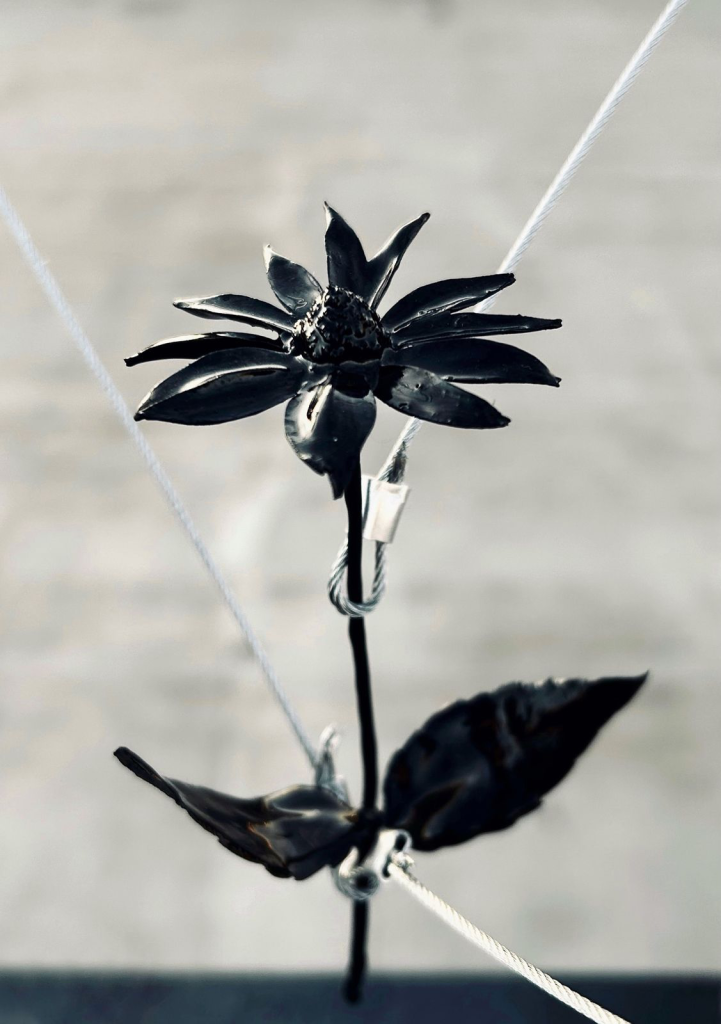
Fanny Spång High Line Park Is a Good Place to Cry, Plexiglass, flowers encased in pigmented epoxy resin, metal wires, steel base.
Fanny Spång, sculpture
High Line Park Is a Good Place to Cry
High Line Park Is a Good Place to Cry is a sculptural installation originally created as a commentary on the Kingsland Wildflowers project (Greenpoint, New York) and humanity’s efforts to reconstruct nature as an act of resilience. It explores the importance of nature in grieving and processing emotions, as well as the longing for nature in urban environments. In doing so, the installation underscores the close connection between sustainable practices and nurturing our well-being..
The inspiration for this project stemmed from a friend who once remarked, “I like the High Line; I go there sometimes to cry. It’s a good place to cry.” These words became the starting point and inspiration for the project’s title and theme: human efforts to restore nature, the importance of natural spaces for emotional processing, the desire to reconnect with the body through nature, and the resilience found in these connections. The sculptural work itself is composed of real flowers encased in pigmented epoxy resin, supported by plexiglass stands, metal wires, and a steel base.
Fanny Spång works within a multidisciplinary practice spanning sculpture, installation, and animation. With a deep fascination for nature and science, she explores organic textures through artificial materials, investigating how sculptural objects can transform our experience of space. Her installations unfold through a detailed, slightly distorted surrealism, exploring states of being and transformation.
She holds an MFA in Design from HDK–Valand, Academy of Art and Design in Gothenburg, and studied at the School of Visual Arts in New York during her BFA. Her work has been shown in Sweden, USA, Germany, and the Czech Republic. As a designer, she has created book covers for publishers throughout Scandinavia. Originally from Sweden, she is based in Berlin, where she works and co-runs the artist-run space Schützenverein.
Krista Autio and Fanny Spång met during an artist residency at Mothership, New York, in the fall of 2024. They both presented exhibitions at NOoSPHERE Arts alongside the residency. During the residency, they engaged in ongoing conversations about art and how their northern homelands have shaped their worldview and artistic practices. It was also at this time that they began developing their respective projects, making this renewed presentation of their works together a natural continuation of an ongoing dialogue.
Sami Sippola sax / Ville Rauhala b / Janne Tuomi dr, perc
Das Trio HOT HEROS gründete sich 2015 in Tampere und besteht aus dem Saxophonisten Sami Sippola, dem Kontrabassisten Ville Rauhala und dem Drummer und Percussionisten Janne Tuomi. Alle drei gehören zur Spitze der Jazzmusiker in Finnland, haben mit diversen Stars gespielt und einige Aufnahmen veröffentlicht.
HOT HEROS begannen mit eher frei improvisiertem Jazz, änderten dann ihren Sound hin zu folk-basierten Themen und lyrischeren Kompositionen, auf deren Basis sie zu ihren weit gedehnten, manchmal exstatischen Improvisationen abheben. HOT HEROS selbst haben schon acht Alben herausgebracht. Das zweite Album ‘Folkjazz From Finland’ wurde für den Jazz-Emma in 2018 nominiert; auf dem vierten Album ‘Vodjanoi’ spielt die berühmte Pianistin Iro Haarla mit.
In Berlin spielen die HOT HEROS folkig angehauchten Jazz, der mit lyrischen Kompositionen und freieren Improvisationen glänzt.
Juha Sääski & Henrik Jacob Galerie/Projektraum TOOLBOX 28.3.-19.4. 2026 Opening 27.3. 2026, 7 pm
Open on Kolonie Weekend Sat: 28.3. 2–5 pm. Sun: 29.3. 2–5 pm
Opening hours: Tue–Fri 2–6 pm
At the end of March, Finnish artist Juha Sääski and Berlin artist Henrik Jacob will present two works that complement each other and fundamentally change the gallery space.
Henrik JacobJuha SääskiJuha Sääski
Street view-street still lifes
Juha Sääski is exhibiting oil paintings which show day-time street views in sleeping places of homeless people in some cities. He is alienating the theme by painting the sleeping accessories, the matresses, blankets, the tents and clothes without the person itself. He is mixing them with street art imagery, sometimes also the person may be drawn with a fragile line either in front of his/her mattress, or on the wall , behind the tent, added in the middle of street art. Often the mattresses, blankets and the tents are very joufully colourful in their gray and dirty surroundings. In the same time this contradiction contains a sad undertone and a human tragedy. The paintings could be described as street view-street still lifes with empathy towards hard life.
Berlin Wall – Another Berlin Wall
In his work “Berlin Wall,” Henrik Jacob also focuses on a peripheral area – a place not at the center of social life, yet one that reveals much about it – the so-called “silent place.” Referencing the floor tiles of the Toolbox Gallery, he extends them into the space and across the walls. He uses modeling clay to gradually insert the toilet wall of an original Berlin bar into the front corner of the gallery. Like Juha Sääski, he is interested in graffiti residue, tags, and stickers as signs of interpersonal communication. At the same time, his installation is an inventory of urban life that transforms, deconsecrates, and humorously expands the gallery’s white cube.
Enjoy to explore!
Deutsch:
Ende März zeigen der finnische Künstler Juha Sääski und der Berliner Künstler Henrik Jacob zwei Arbeiten, die sich gegenseitig bezugnehmend ergänzen und den Galerieraum grundlegend verändern.
Straßenansichten – Stillleben der Straße
Juha Sääski zeigt Ölgemälde, die die Schlafplätze von Obdachlosen im Tageslicht und in verschiedenen Städten zum Motiv haben. Er nähert sich dem Thema, indem er Schlafutensilien wie Matratzen, Decken, Zelte und Kleidung ohne die dazugehörige Person abbildet. Die einzelnen Elemente kombiniert er mit Street-Art- Motiven. Zuweilen sind die Eigentümer der vorgefundenen Habseligkeiten als zarte Linie vor einer Matratze oder an einer Wand hinter einem Zelt angedeutet und so in die Street-Art-Szenerie eingebunden. Im Kontrast zu ihrer grauen und schmutzigen Umgebung sind die Decken, Zelte und Matratzen oft in farbenfrohen, leuchtenden Tönen gemalt. Dieser Widerspruch verstärkt den traurigen Unterton der Bilder und der menschlichen Tragödien dahinter. Die Arbeiten könnten als Straßenansichten – Stillleben – oder Stilleben der Straße beschrieben werden. Sie vermitteln zugleich ein Mitgefühl für das harte Leben am Rand der Gesellschaft.
Berlin Wall – eine andere Berliner Mauer
Auch Henrik Jacob widmet sich in seiner Arbeit „Berlin Wall“ eher einem Nebenschauplatz – einem Ort, der nicht im Zentrum des gesellschaftlichen Lebens steht und dennoch viel über dieses aussagt – dem sogenannten „stillen Ort“. Bezugnehmend auf die Fliesen des Fußbodens der Toolbox Galerie verlängert er diese in den Raum hinein und über die Wände. Dabei benutzt er den Werkstoff Knete um Schritt für Schritt die Toilettenwand einer Original – Berliner Bar in die vordere Ecke der Galerie einzufügen. Wie auch Jaha Sääski interessieren ihn dabei Graffiti- Rückstände, Tags und Sticker als Zeichen zwischenmenschlicher Kommunikation und nicht zufällig erinnert die Wandinstallation aus bunter Knete auch an eine ausufernde Timeline mit Kommentaren und Bildern in den sozialen Medien. Zugleich ist seine Installation eine Momentaufnahme des urbanen Lebens, die den White Cube der Galerie transformiert, entweiht und humorvoll erweitert.
Viel Vergnügen beim Erkunden!
Galerie/Projektraum TOOLBOX Koloniestraße 120 13359 Berlin-Wedding U-Bahn Osloer Straße
An Feiertagen ist die Toolbox geschlossen On Bank holidays Toolbox is closed
Open on Kolonie Weekend: Sunday 01.03. : 2-6 pm | 14-18 Uhr
Exhibition | Ausstellungsdauer: 1.–21.03.2026
Sonic Wonderland – Visuo-Acoustic Simulations of Echoing Rocks
Jami Pekkanen, Julia Shpinitskaya, Noora Vikman, Elina Hytönen-Ng, Gjermund Kolltveit, Riitta Rainio
Sonic Wonderland’s visuo-acoustic simulations take visitors to some of Finland’s most stunning acoustic environments: the echoing rock paintings of Siliävuori and the resonant cavity of Hiidenkirnukivi. Digital modeling and auralization methods conjure up what these sacred sites of the past look and sound like. The simulations are interactive, which means that in order to hear the echoes, visitors must produce sound themselves, for example by calling out, clapping, or playing the instrument
The SacredSounds research project, funded by the Kone Foundation (2023–2027), traces and highlights the unrenowned acoustics heritage of Fennoscandia. Researchers from the Universities of Helsinki and Eastern Finland perform acoustic measurements at cliffs, boulders, caves, and gorges held as sacred or special, and document the sites using LiDAR scanning, aerial videography, and photography. They also conduct archival research and interviews to find out how people have experienced these places at different times.
For the past five years, fish have been my subject matter. Pike-perch, perch, and herrings – sometimes lying on wax paper, sometimes on a plate. What is it about these shiny creatures that fascinates me?
Still-life painting fascinates me. It is about learning to look at things. The history of painting is full of still lifes of fish – silver-sided fish on silver platters, coarse fish scales depicted together with translucent onions, or moist seafood gleaming on the dirty counter of a market stall. As a motif, a fish is loaded with meanings, often Christian ones. Above all, it often seems to reflect the pure joy of painting – the pleasure that comes from seeking light and shine. Of course, fish themselves are intriguing too. Smelly, even repulsive, oblong creatures, strange and mute. Fish are valuable yet unfamiliar, lifted up from beneath the surface for food. The boundary between two worlds is broken just like that.
Most of all, however, I am interested in the similarity. The fish is matter, just like the painting, the viewer, and the painter. The same clammy, speechless substance. By painting fish, I paint all of us – chunks of flesh dragged into this unfamiliar environment without asking.
My sculptures address the experience of life being limited, our dependence on our own physical existence and especially on other people.
A human is part of a human community. The fields of our social interactions largely define the framework of our actions. Even our separation and isolation always stand in relation to others. Our ability to be intimate is the starting point of our existence. Our ability to take care carries us from one generation to another. Independence is inevitable, yet even our independence stands in relation to others, our diverse communities.
As neither the fields of interaction surrounding us nor our relations to others can be physically touched by the hand, we need sculptures to concretize these abstract experiences. In my view and experience, a sculpture still is a functioning means of symbolic thinking for human communities. In practice, this has already been the case since early cult objects. Creating a sculpture is slow, at least for me. My themes develop slowly, if at all. My topics of limitations and dependence on others intertwine and reveal themselves repeatedly. The material’s resistance is important to me. The physicality of creating a work is often enjoyable. The slowness in working with the material and the physical effort create time for thinking and for the opportunity to calmly solve sculptural problems.
I tend to get the impression that the slowness in making a sculpture does not prevent, but in fact assists the sculpture opening up to its viewer as an abrupt experience, even resembling a physical shock. The viewer is important to me. The sculpture is a means to communicate with and within the community.
Maija Helasvuo Sculptor, MFA
Deutsch e Übersetzung des Textes von Maija Helasvuo:
Meine Skulpturen thematisieren das Erlebnis der Begrenztheit des Lebens, unsere Abhängigkeit von der eigenen physischen Existenz und insbesondere von anderen Menschen. Ein Mensch ist Teil menschlicher Gemeinschaft. Unsere sozialen Interaktionsfelder bestimmen zu großen Teilen die Rahmenbedingungen unseres Handelns. Sogar unsere Abgrenzung und Isolation stehen immer in Beziehung zu anderen. Unsere Fähigkeit zu Intimität ist der Ausgangspunkt unserer Existenz. Unsere Fähigkeit sich um andere zu sorgen trägt uns von Generation zu Generation. Selbstständigkeit ist unabdingbar, und doch steht auch sie in Beziehung zu anderen, zu unseren vielfältigen Gemeinschaften.
Da wir weder die uns umgebenden Interaktionsfelder noch unsere Beziehungen zu anderen mit den Händen greifen können, brauchen wir Skulpturen als eine Konkretisierung unserer abstrakten Erlebnisse. Ich fühle und sehe Skulpturen weiterhin als funktionierendes Mittel des symbolischen Denkens menschlicher Gemeinschaften. Tatsächlich gilt dies bereits seit frühzeitlichen Kultobjekten.
Galerie/Projektraum TOOLBOX Koloniestraße 120 13359 Berlin-Wedding U-Bahn Osloer Straße
An Feiertagen ist die Toolbox geschlossen On Bank holidays Toolbox is closed