You are warmly welcome to our next opening.
Zentrum für unbequeme Wahrheiten | Center for Uncomfortable Truths
Galerie/Projektraum TOOLBOX presents an exhibition with:
Jukka Korkeila & Michael Kirkham
Exhibition: 25.6.–24.7.2026
Opening Fri 26 June 2026: 6–10 pm
Open on Kolonie Weekend
Sat 27 June: 2–5 pm
Sun 28 June: 2–5 pm
Special event:
Opening hours: Tue–Fri 2–6 pm
For English, please scroll down
In den letzten Jahren scheint die Welt unwiderruflich verrückt geworden zu sein. Russland marschierte in die Ukraine ein und im Gazastreifen brach der Krieg aus. Trump griff den Iran an. Finnland (2023) und Schweden (2024) traten überstürzt der NATO bei. 2025 trat Finnland aus dem Ottawa-Vertrag (Minenverbotsvertrag) aus. Nordkorea schloss sich dem Krieg gegen die Ukraine an. Ein neuer Kalter Krieg begann und Die Raketen Nordkoreas und Russlands sind auf die NATO-Mächte gerichtet, also auch auf uns.
In Helsinki hörte ich im Nahverkehrszug leichtfertig über Putins Bombenangriffe sprechen und fragte mich, wann es wohl auch hier (in Finnland) so weit sein würde. Der finnische Rundfunk (YLE) zeigt seit Jahren Filme und Dokumentationen über den Krieg. Wenn ich die YLE-Programme sehe, kommt mir unweigerlich der Gedanke, dass wir Finnen uns auf einen Krieg vorbereiten. Konkrete Vorbereitungen laufen bereits: So baut beispielsweise der finnische Sprengstoffhersteller Forcit in Pori eine TNT-Fabrik, in der auch genügend Material für Antipersonenminen produziert werden kann.
In Finnland hat sich die allgemeine Stimmung innerhalb weniger Jahre in Richtung Aufrüstung gewandelt. Waffen werden positiv dargestellt. Stanley Kubricks Film „Dr. Seltsam oder: Wie ich lernte, die Bombe zu lieben“ aus dem Jahr 1964 ist heute wieder aktuell. Der Film ist eine politische Satire und schwarze Komödie über den Schatten der Atombombe. Indiens erster erfolgreicher Atomtest am 18. Mai 1974 trug den Namen „Lächelnder Buddha“, der vom US-amerikanischen Militärgeheimdienst den Codenamen „Happy Krishna“ erhielt. Warum lächeln Raketen und Bomben? Woher kommt diese Widersprüchlichkeit? Was bringt uns zum Lächeln angesichts der drohenden Selbstzerstörung?
Wir müssen dieser gängigen Meinung jedoch nicht zustimmen. Wir können anders denken. Doch inmitten dieser Dunkelheit gibt es Licht, das in den Herzen der Menschen und ihrer Lebenslust zu finden ist. Jeder Mensch ist ein Licht in dieser Dunkelheit. Dunkle Zeiten schaffen einen Kontext für das Leben, aber wir sollten diese Düsternis mit Lebensfreude überwinden – genau das möchte diese Ausstellung vermitteln. Freude sollte jeden Tag im Atelier zu finden sein, und ein Hauch von Freude sollte in jedem Kunstwerk spürbar sein.
Über Jukka Korkeila
Jukka Korkeila (geb. 1968 in Hämeenlinna) zählt zu den bedeutendsten Malern Finnlands. Seine Werke wurden in zahlreichen Museen und Galerien weltweit ausgestellt. Er lebt und arbeitet an drei Orten: Berlin, Glauburg-Stockheim und Helsinki. Korkeila hat an Ausstellungen in ganz Europa teilgenommen, und alle wichtigen nordischen Sammlungen führen seine Arbeiten. Er hatte Einzelausstellungen im Moderna Museet in Stockholm und im Nordischen Aquarellmuseum in Skärhamn, Schweden. 2014/15 nahm Korkeila an der vierten Biennale del Fin del Mundo in Mar del Plata, Argentinien, teil. 2017–2018 nahm er an der umfangreichen Retrospektive „Pleasure“ im Kunstmuseum Helsinki (HAM) und im Serlachius Museum in Mänttä teil. 2018 war Korkeilas Werk in der von Luc Tuymans kuratierten Ausstellung „Sanguine/Bloedrood“ im Museum für Zeitgenössische Kunst Antwerpen (MHKA) in Belgien vertreten. 2019 wurde Korkeila mit dem finnischen Staatspreis für Bildende Kunst ausgezeichnet. 2022 nahm Korkeila an der Biennale „Le Latitudini dell’Arte V ed. Sweden and Italy“ im Palazzo Ducale in Genua teil, kuratiert von Paul Thomassen. Ebenfalls 2022 war Korkeila an der von Max Hannus kuratierten Ausstellung „Dreamy“ im Museum für Zeitgenössische Kunst Kiasma in Helsinki beteiligt. Im Jahr 2023 wurden seine Gemälde aus der Sammlung des Kunstmuseums Malmö in die Ausstellung „Happily Ever After“ im Kunstmuseum Malmö aufgenommen, kuratiert von Julia Björnberg und Anna Johansson. 2024 wurde das Gemälde „Art of Falling Apart“ aus der Sammlung des Moderna Museet in Stockholm in der Ausstellung „Den Tredje Handen, Maurizio Cattelan and Moderna Museet’s collection“ im Moderna Museet gezeigt, kuratiert von Maurizio Cattelan. 2025 fand im Kunstmuseum Hämeenlinna in Hämeenlinna, Finnland, eine große Retrospektive von Korkeila mit dem Titel auf Finnisch „Pimeys on täynnä valoa“ (Die Dunkelheit ist voller Licht) statt, kuratiert von Soile Ollikainen. In Berlin fand auch eine gleichnamige Ausstellung bei Wolf & Galentz im Herbst 2025 statt.
Michael Kirkham
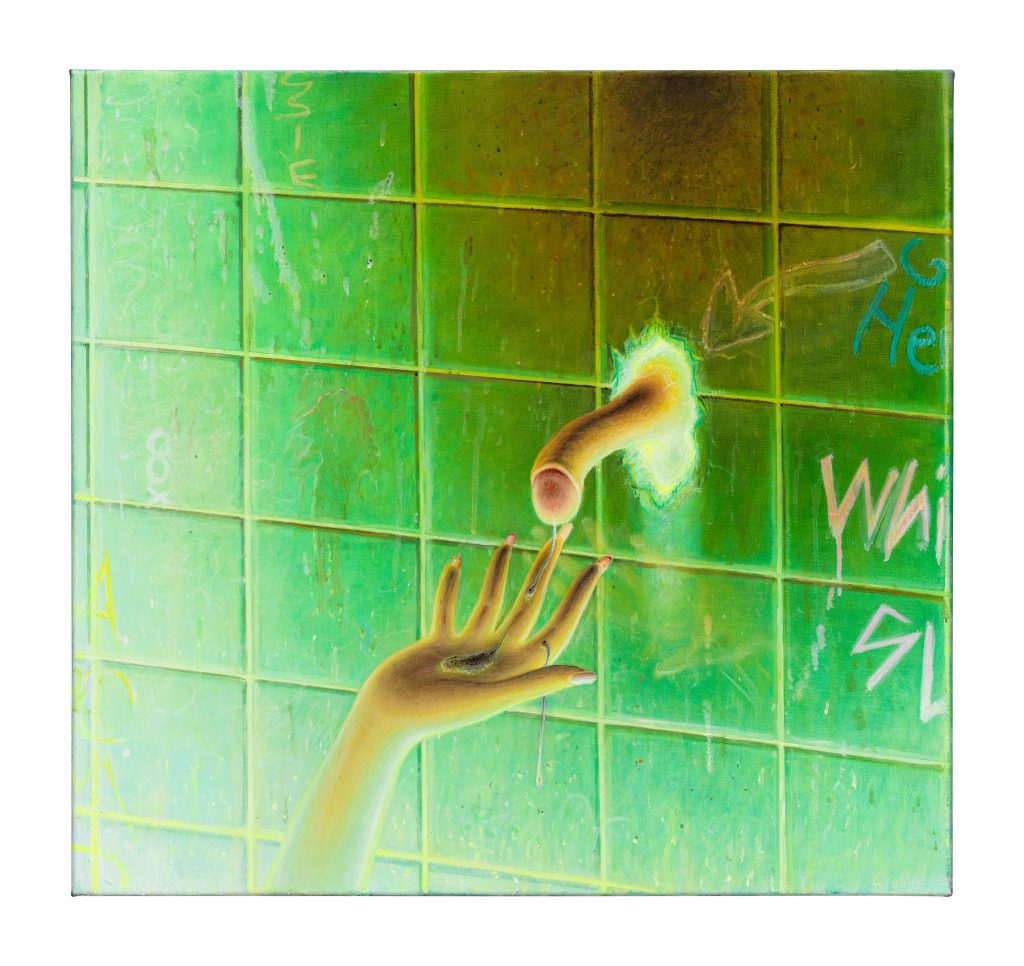
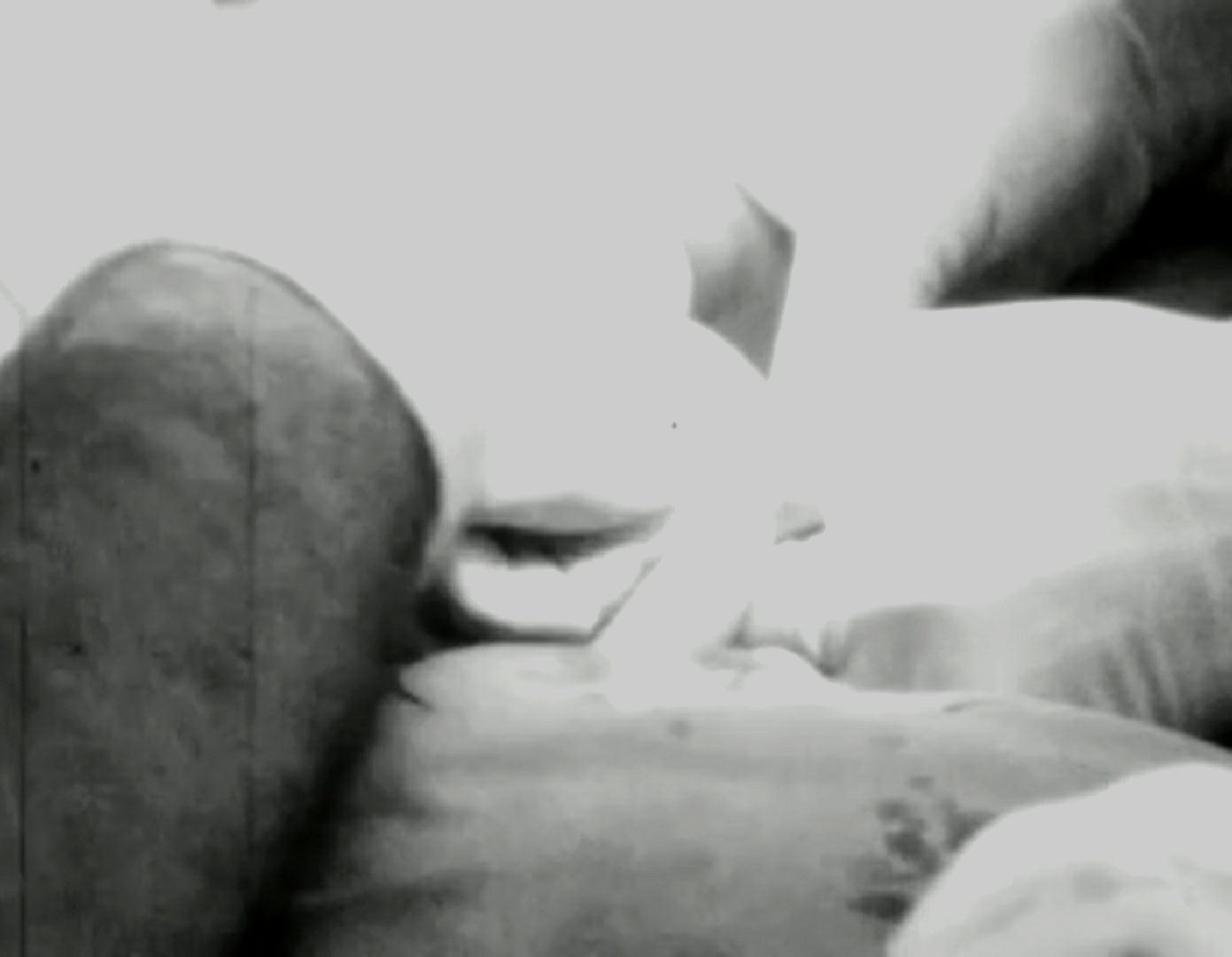
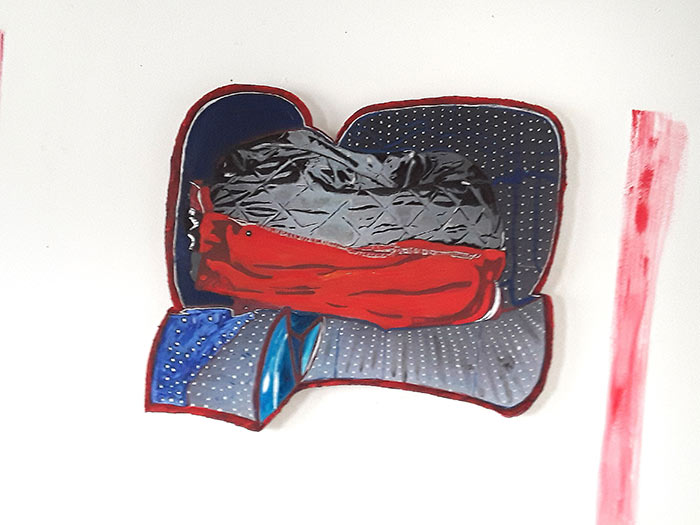
Abb.: Gloryhole 2, Michael Kirkham
Diese Präsentation mit dem Titel „Eine Kleine Riss“ zeigt – begleitend zu Jukkas
Einzelausstellung in der Toolbox – vier kleinformatige Gemälde und thematisiert mithilfe
stark kontrastierender negativer Farbschemata, wie Licht aus Bildschirmen, Fenstern,
Öffnungen, Mündungen und Löchern entweicht oder strömt. Text (einschließlich Auszügen
aus dem Interview mit George Kratochvil vom 22. März 2026)
„Das Sehen funktioniert ganz ähnlich wie eine Kamera: Wenn Licht ins Auge fällt, wird es
von der Linse auf den Sehnerv projiziert. Fotografien oder Filme beispielsweise sind
mechanische Aufzeichnungen dieses ‚optischen Rohmaterials‘, die jedoch auf digitalen oder
chemischen Trägern festgehalten werden. Die Spuren, die das Licht hinterlässt, wirken
realistisch; sie erscheinen uns als wahre Abbilder der Welt um uns herum. (Die Tatsache,
dass sie mechanisch erzeugt sind, hat dazu geführt, dass sie gewissermaßen als ‚die
Wahrheit‘ fetischisiert wurden – eine Auffassung, die natürlich inzwischen durch
Photoshop, KI und Ähnliches untergraben wurde.) Dies liegt daran, dass unser visueller
Kortex gelernt hat, sie genau als solche zu interpretieren. Diese ‚Objektivität‘ möchte ich in
meinen Gemälden aufgreifen und thematisieren. Die Idee, mit Negativfarben zu arbeiten,
entsprang diesem Ansatz – vor allem aber resultierte sie aus farblichen Experimenten. Ich
bin mir sicher, dass manche Leute dies vielleicht lediglich als einen ‚Trick‘ abtun;
tatsächlich besteht die Methode jedoch schlichtweg darin, helle Farben für die
Schattenbereiche zu verwenden und von dort aus weiterzuarbeiten. Dies hebt das Gemälde
unmittelbar auf eine quasi-abstrakte Ebene; zudem ist es faszinierend zu beobachten, wie
Hauttöne in ihrer negativen Darstellung erscheinen – sie sind dabei nicht zwangsläufig grün.
Auch sämtliche Unreinheiten auf den Oberflächen werden auf diese Weise ‚erhellt‘, und
ebenso wird alles beleuchtet, was eine ‚Vertiefung‘ oder ein ‚Loch‘ darstellt – wie etwa der
Mund. Insgesamt eröffnet dieser Ansatz ein hohes Maß an gestalterischer Freiheit im
Umgang mit Farben und kann zu äußerst eigenwilligen Farbkombinationen führen.
Möglicherweise geht es dabei auch darum, einen Widerspruch zu erzeugen: ein Bild, das
zugleich strahlend hell und doch von Melancholie erfüllt ist. Obwohl ich die entsprechende
Technik durchaus beherrschte, entwickelte ich irgendwann eine gewisse Ambivalenz
gegenüber der naturgetreuen, naturalistischen Wiedergabe von Figuren – sei es nach Modell
oder, noch stärker ausgeprägt, nach fotografischen Vorlagen. Schließlich entschied ich mich
dazu, gänzlich ohne Vorlagen zu arbeiten: keine gefundenen Fotos, keine Modelle. Meine
Bilder sollten fortan als ‚projizierte Bilder‘ im Sinne von inneren Vorstellungen entstehen –
als Versuche, etwas zu visualisieren, das physisch gar nicht vorhanden war. Naturalismus
oder Realismus reduzieren sich in diesem Kontext auf bloße stilistische Qualitäten – auf
Elemente, die man einem Gemälde nach Belieben hinzufügen oder wieder entziehen kann.
Infolgedessen gewann die Auseinandersetzung mit dem Surrealismus für mich an
Bedeutung – wenngleich ich das Gefühl hatte, dass der Surrealismus in seiner
Herangehensweise etwas verfehlt hatte. Er erschien mir zu stark theoretisiert, und seinen
Theorien fehlte meines Erachtens ein entscheidendes Element. Genauer gesagt: Die Fantasie
ist keineswegs losgelöst von … …die Realität – wie in einem Traum, in dem man nicht bei
Bewusstsein ist; wobei die Trennlinie zwischen den Erzeugnissen der Fantasie und den
Träumen sicherlich weitaus fließender verläuft. Wer jemals halluzinogene Drogen
konsumiert hat, kann bezeugen, wie radikal dabei in die Funktionsweise der Sehrinde
eingegriffen werden kann. Es ist, als würde das Gewebe oder die „Matrix“ der banalen
Wahrnehmung – die wir als selbstverständlich hinnehmen (um normal funktionieren zu
können) – mit Leichtigkeit Risse bekommen oder zerreißen; und es ist ein ziemlicher
Schock, ja sogar eine Offenbarung, zu erkennen, in welchem Ausmaß unsere normale,
alltägliche Wahrnehmung der Realität tatsächlich eine fragile und kunstvolle Konstruktion
darstellt – eine Konstruktion, die beständig aufrechterhalten werden muss. In gewissem
Sinne ist also selbst der banale Akt der visuellen Wahrnehmung fortwährend von Fantasie
durchdrungen und mit ihr verwoben – und folglich auch mit sämtlichen Emotionen; etwa
mit der Furcht vor dem Gesehenen oder dem Begehren nach ihm. Um es noch einmal zu
betonen: Es handelte sich hierbei um einen „Surrealismus des Banalen“ – fast wie eine Art
„Realitätsverschiebung“ (Reality-Shift) … doch wie genau sieht das aus? Es muss
zwangsläufig etwas Visuelles sein, eine spezifische Qualität der Visualität … und somit eher
ein Produkt der Intuition als des Intellekts. Was ich hier skizziert habe, ist ohnehin keine
eigentliche Theorie, sondern vielmehr ein Ansatz …
English
During the last years the world seems to have gone irrevocably crazy. Russia invaded Ukraine and war broke out in Gaza. Finland (2023) and Sweden (2024) hastily joined NATO. In 2025, Finland withdrew from the Ottawa Treaty (the Mine Ban Treaty). North Korea joined the fight against Ukraine. Trump attacked Iran. A new Cold War began. North Korean and Russian missiles are aimed at NATO powers, then at us.
In Helsinki, I heard people talking carelessly on the local train about Putin’s bombings, so when will it happen here (in Finland)… Finnish Broadcasting Corporation (YLE) has been showing films and documentaries about the war for several years now. When I watch Finnish Broadcasting Corporation’s (YLE´s) programs, it inevitably occurs to me that we Finns are preparing for war. Concrete preparations are already underway: for example, the Finnish explosives manufacturer Forcit is building a TNT explosives factory in Pori, Finland, from which there is also enough material for anti-personnel mines.
In Finland, the general mood has changed to a pro-armament one in a couple of years. Weapons have been given a positive label. Stanley Kubrick’s 1964 film, Dr. Strangelove, or: How I Learned to Stop Worrying and Love the Bomb, is once again relevant. The film is a political satire and black comedy about the shadow of the bomb. India’s first successful nuclear test on May 18, 1974, was named Smiling Buddha, which the US military intelligence codenamed “Happy Krishna.” Why do missiles and bombs smile? Where does this schizophrenia come from? What makes us smile on the verge of self-destruction?
However, we do not have to agree with this prevailing narrative. We can think differently. But amidst this darkness there is light, which can be found in people’s hearts and the lust for life they have. Every person is a light in this darkness. Dark times create a context for life, but we should overcome this gloom with joy of life, which is what this exhibition aims to do. Joy should be found in every day in the studio and glimpses of joy should be found in every work done.
11.5.2026 in Glauburg-Stockheim, Jukka Korkeila.
About
Jukka Korkeila (born 1968, Hämeenlinna) is one of Finland’s foremost painters; his work has been exhibited in various museums and galleries around the world. He lives and works in three places: Berlin, Glauburg-Stockheim and Helsinki. Korkeila has participated in exhibitions around Europe, and all the major Nordic collections include his work. Korkeila has had solo exhibitions at the Moderna Museet in Stockholm and the Nordic Watercolor Museum in Skärhamn, Sweden. In 2014–2015, Korkeila participated in the fourth Biennal del Fin del Mundo in Mar del Plata, Argentina. In 2017–2018, he participated in the extensive retrospective exhibition Pleasure at the Helsinki Art Museum, HAM, and the Serlachius Museum in Mänttä. In 2018, Korkeila’s work was included in the exhibition Sanguine/Bloedrood, curated by Luc Tuymans, at the Museum of Contemporary Art Antwerp (M HKA) in Belgium. In 2019, Korkeila was awarded the Finnish State Prize for visual arts. In 2022, Korkeila participated in the Biennale Le Latitudini dell’Arte V ed. Sweden and Italy at Palazzo Ducale, Genoa, Italy, curated by Paul Thomassen. In 2022, Korkeila participated in the exhibition Dreamy at the Museum of Contemporary Art Kiasma, Helsinki, Finland, curated by Max Hannus. In 2023, his paintings from Malmö Art Museum’s collection were included in the Happily Ever After exhibition at Malmö Art Museum, curated by Julia Björnberg and Anna Johansson. In 2024, the painting Art of Falling Apart from Moderna Museet’s collection was shown – at Den Tredje Handen, Maurizio Cattelan and Moderna Museet’s collection – exhibition at Moderna Museet, Stockholm, curated by Maurizio Cattelan. In 2025, Korkeila had a major retrospective exhibition, Pimeys on täynnä valoa (Darkness is full of light), at the Hämeenlinna Art Museum in Hämeenlinna, Finland, curated by Soile Ollikainen. The exhibition of the same name, Dunkelheit ist voller Licht (Darkness is full of light), coincided with Wolf & Galentz in Berlin last autumn.
Finnish Arts and Culture Authority, who have supported my work.
Michael Kirkham
The Small Tear/Eine Kleine Riss
This presentation entitled “Eine Kleine Riss( A Small Tear”) shows 4 small format paintings
alongside Jukka´s solo exhibition at Toolbox,- thematises how light escapes or streams
from screens, windows ,openings , orifices, and holes by the use of strong contrasting
negative colour schemes.
Text (including exerpts ,Interview with George Kratochvil March 22 2026)
“Vision functions a lot like a camera: when light enters the eye it is projected on to the optic
nerve by the lens. Photographs or films for example, are mechanical registrations of this
“raw optical material” but captured on digital or chemical plates. The traces left by the light
look realistic, they seem like true pictures of the world around us. (That they are
mechanically produced has led to them being somewhat fetishised as “the truth”— this has
of course been now undermined by Photoshop and AI etc).This is because our visual cortex
has learned how to turn them in to such .I want to use and refer to this “Objectivity” in my
paintings. The origin of using negative colours came out of this but mostly of colour
experiments. I´m sure some people might just see it as a “trick” , but actually all it is is using
a bright colour in the shadow, and then going from there. It takes the painting
immediately on to a quasi- abstract level and it is fascinating how skin colours appear in a
negative. They are not necessarily green. Also all the dirt on the surfaces is “lit-up”, and
anything that is a “hole” is also illuminated.. mouths for instance. It anyway allows a lot of
freedom in colour use , and can result in very weird colour combinations. It may also have
something to do with making a contradiction–a very bright but melancholy image.
Although rather skilled at it, at some point I developed an ambivalence to faithful,
naturalistic reproductions of figures from models etc.,even more so towards painting from
photographs. I eventually decided to work from nothing at all: No found photos, no models.
They would be “Projected Images” in the sense that I would try to visualise something that
was not there. Naturalism or Realism then become just certain qualities among others that
can be added or removed from a painting. A relationship with Surrealism became important
because of this, although it seemed to me that Surrealism had done it wrong. It was too
theoretical and their theories missed something. More specifically: Fantasy is not actually
removed from reality-as in a dream where you are not conscious, but that the division
between the products of the imagination and dreams is certainly more fluid. Anyone who
has ever taken hallucinogenic drugs can report how the visual cortex can be radically
interfered with. It’s a though the fabric or “matrix” of banal perception that we take for
granted ( in order to function normally )is easily cracked or torn, and it’s rather a shock ,
even a revelation to notice the extent to which our normal everyday perception of Reality is
actually a delicate and elaborate construction: a construction which must be constantly
maintained. So in a sense , even the banal act of visual perception is constantly affected and
intertwined with fantasy.. and therefore with all emotions. fear or desire for or of what you
see for example. To emphasise: It would be a Surrealism of the Banal, almost like a kind of
“Reality- Shift”.. but what does that look like? It’s got to be a visual thing, a quality of
visuality.. so it’s more a product of intuition.. not of the intellect . What I outlined here is
anyway not really a theory , it’s more of an approach. ..”
MK 2026